Why Are Interactive Slide Projector Games Becoming the Best Choice for Kids’ Playgrounds?
Traditional playground structures still have value, yet modern families increasingly expect a more dynamic and memorable environment. Therefore, many playground operators now look for the latest digital attractions that combine physical movement with smart technology.
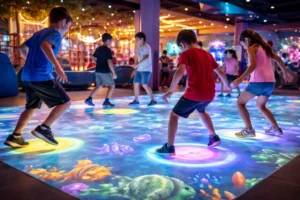
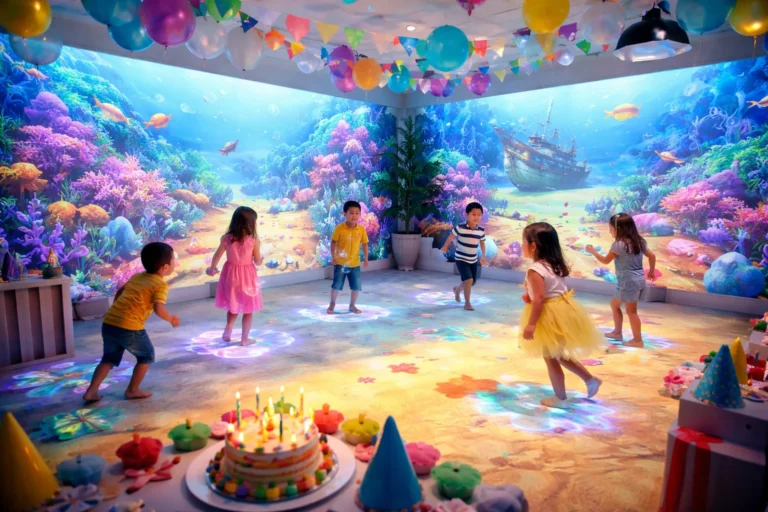
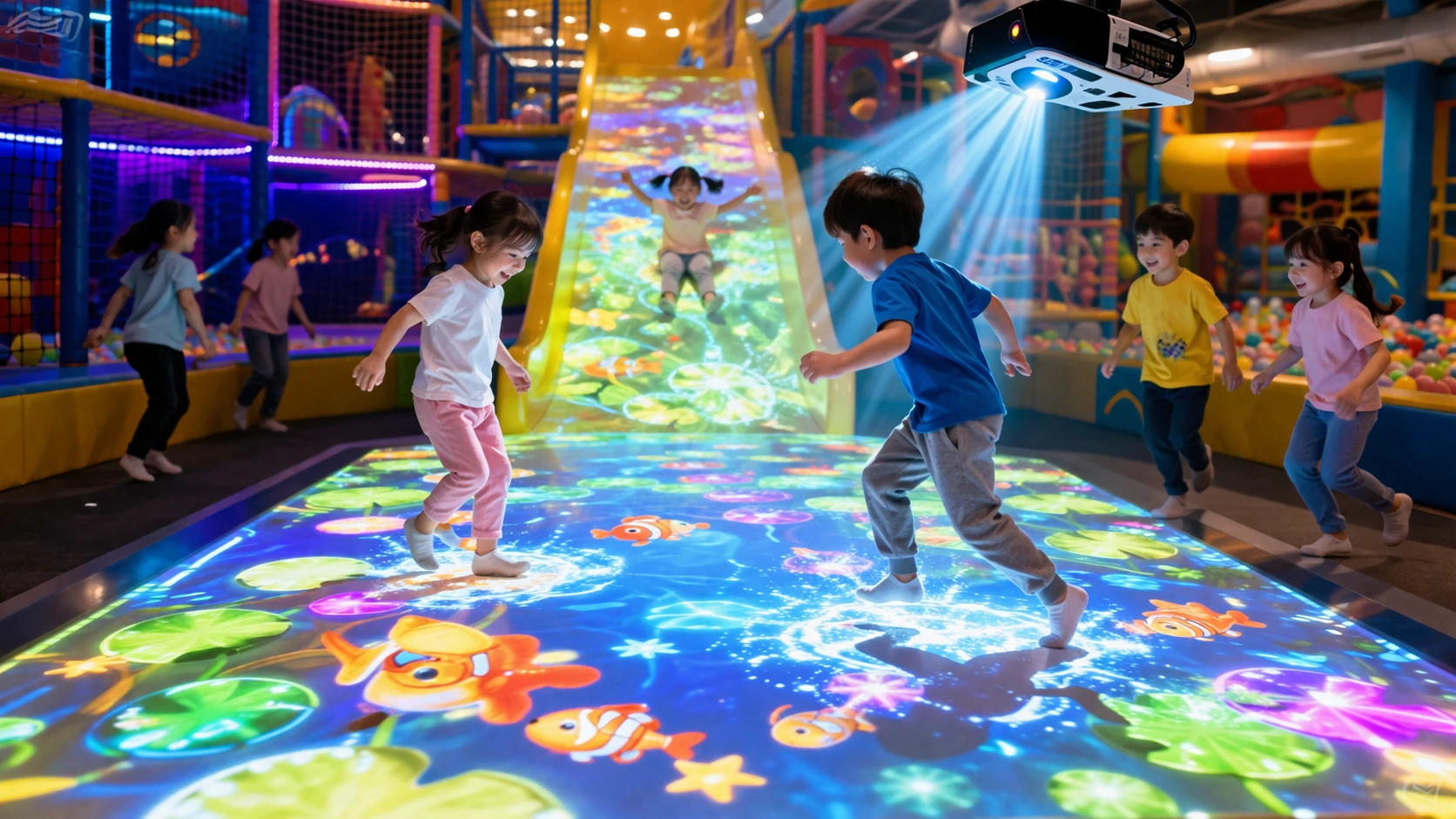
An interactive slide projector game system does exactly that. It projects animated content onto the slide landing area, staircase zone, or surrounding floor. Then, the system detects the child’s movement and responds in real time. Consequently, a normal slide becomes part of a responsive game world.
This type of game offers several clear benefits:
✦ It increases repeat play value
✦ It encourages active movement instead of passive watching
✦ It supports themed storytelling and educational play
✦ It creates a modern image for the playground company
✦ It helps operators stand out from nearby competitors
What Should Be Included in an Implementation Plan for an Interactive Slide Projector Game System?
A successful implementation plan should do more than list products to buy. Instead, it should define how the full system will work from concept to long-term operation.
A professional implementation plan should include the following elements:
1. Site Evaluation
First, assess the slide dimensions, ceiling height, wall distance, landing zone, and ambient light level. This step is essential because projector performance depends heavily on installation conditions.
2. Game Theme Planning
Next, decide what kind of game experience you want. Should it be ocean-themed, jungle-themed, space-themed, or educational? This choice affects the software design and visual content.
3. Equipment Selection
Then, select the right projector, motion sensor, media controller, mounting structure, and audio support. The best hardware depends on the size of the area and the traffic level.
4. Safety and Traffic Flow
After that, plan how children move into and out of the slide zone. The implementation plan must ensure the game does not create congestion or unsafe behavior.
5. Content and Software Configuration
The software is the heart of the system. It controls animation, response logic, sound effects, and scoring. Therefore, the software must match the age group and the pace of the playground.
6. Budget and Price Control
Finally, define the total price range, including hardware, installation, content creation, testing, and after-sales support.
How Do You Choose the Best Location for Interactive Slide Projector Games in a Playground?
Location planning is one of the most important parts of the project. Even the best projector and software can underperform if they are placed in the wrong environment.
When evaluating the location, ask these questions:
Is the light level controlled?
Projector-based game systems work best in moderate to low ambient light. If the play area is too bright, the images may appear washed out. Therefore, many operators use ceiling treatments, shaded covers, or controlled lighting to improve visibility.
Is the slide exit zone wide enough?
The landing area should provide enough space for projected content and for safe child movement. A narrow exit may reduce interaction quality and increase crowding.
Is the ceiling high enough for mounting?
The projector and sensor need the proper projection angle. If the ceiling is too low or poorly positioned, the system may not deliver the expected effect.
Is the area visible to parents and staff?
A good layout balances immersion with supervision. Parents should still be able to observe children, and staff should have a clear line of sight.
Can the location support expansion later?
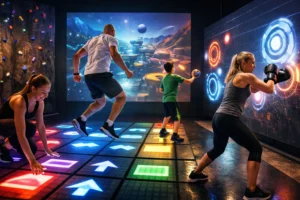
A smart implementation plan should consider future upgrades. For example, an operator may want to add interactive floor games or wall projection games later.
Below is a useful comparison table for planning the installation area:
| Evaluation Factor | Good Condition | Risk if Ignored | Recommendation |
|---|---|---|---|
| Ambient light | Controlled or dimmable | Weak projection effect | Use shade control or adjust lighting |
| Slide landing size | Spacious and open | Congestion and safety issues | Leave enough interaction zone |
| Ceiling structure | Stable and mount-ready | Difficult installation | Confirm mounting points early |
| Staff visibility | Easy to monitor | Poor supervision | Keep line of sight open |
| Power and wiring | Nearby and concealed | Messy setup and higher cost | Plan power routing before install |
| Expansion potential | Space for upgrades | Limited future value | Reserve flexible layout area |
Which Hardware and Software Components Should You Buy for an Interactive Slide Projector Game?
Many buyers focus only on the projector itself. However, the full system includes several important parts. To get the best result, the operator should buy a complete, well-matched package rather than mixing unrelated products from multiple store listings.
Core hardware components include:
✦ High-brightness projector
✦ Motion tracking sensor or camera
✦ Media server or control unit
✦ Mounting bracket and protective housing
✦ Audio output system
✦ Control interface for content switching
Core software components include:
✦ Interactive game engine
✦ Motion response software
✦ Theme-based animation package
✦ Content scheduling tools
✦ Score or reward logic
✦ Maintenance and update interface
How Can Playground Operators Compare the Advantages and Disadvantages of Interactive Slide Projection Games?
Before investing, many buyers want to compare the benefits and possible limitations. That is a smart step, because it leads to better budget and operational decisions.
Here is a simple advantages and disadvantages table:
| Aspect | Advantages | Disadvantages |
|---|---|---|
| Child engagement | Highly immersive and exciting | Needs fresh content to stay new |
| Visual appeal | Creates a modern and premium image | Performance depends on light control |
| Flexibility | Themes can be updated through software | Custom content may increase price |
| Installation value | Works with existing slide structures | Some sites need ceiling or wiring adjustment |
| Business impact | Helps attract families and repeat visits | Requires maintenance and periodic calibration |
| Branding opportunity | Supports unique company identity | Poor setup can reduce effect |
What Step-by-Step Process Should a Company Follow to Implement the System Successfully?
A professional implementation plan should follow a clear sequence. This improves efficiency and reduces technical problems during setup.
Step 1: Define the playground goal
Start by deciding what role the game will play. Is it the main attraction, a supporting feature, or part of a themed zone?
Step 2: Survey the site
Measure the area, lighting, ceiling conditions, and power access. Then document the slide layout and traffic flow.
Step 3: Select the supplier
Choose a reliable supplier, maker, or manufacturer with real experience in interactive projection systems.
Step 4: Confirm game content and software
Review game themes, interaction style, age suitability, and update options.
Step 5: Finalize quotation and order
At this stage, confirm the price, delivery scope, installation support, and maintenance plan before placing the order.
Step 6: Prepare the site
Complete ceiling mounting preparation, wiring, lighting adjustment, and protection measures.
Step 7: Install and calibrate the system
Mount the projector and sensors, load the software, test the interaction zone, and adjust alignment.
Step 8: Train staff
Teach the team how to start, stop, clean, and manage the system daily.
Step 9: Launch and monitor performance
After launch, observe child behavior and staff feedback. Then optimize settings if needed.
Step 10: Refresh content over time
To keep the attraction exciting, rotate the latest themes and seasonal games.
It is a system that uses a projector, sensor, and interactive software to create responsive game effects around a playground slide. Children trigger visual and audio reactions through movement.
Yes, it can be safe when the landing area is properly designed, the equipment is securely mounted, and the game flow is planned to avoid crowding.
Yes. Many supplier and manufacturer companies offer custom software themes, branded animation, and age-specific game content as part of the order.
Routine checks should be done regularly. Cleaning, calibration, software updates, and hardware inspection help maintain the best performance.