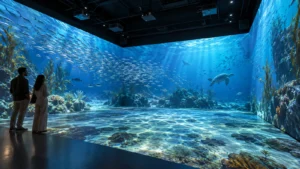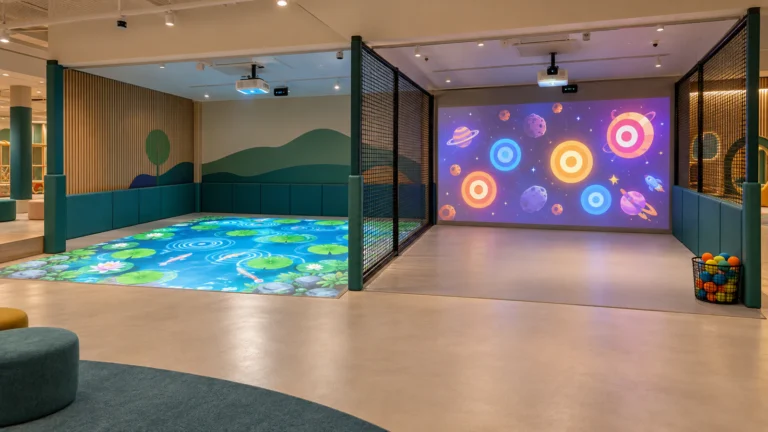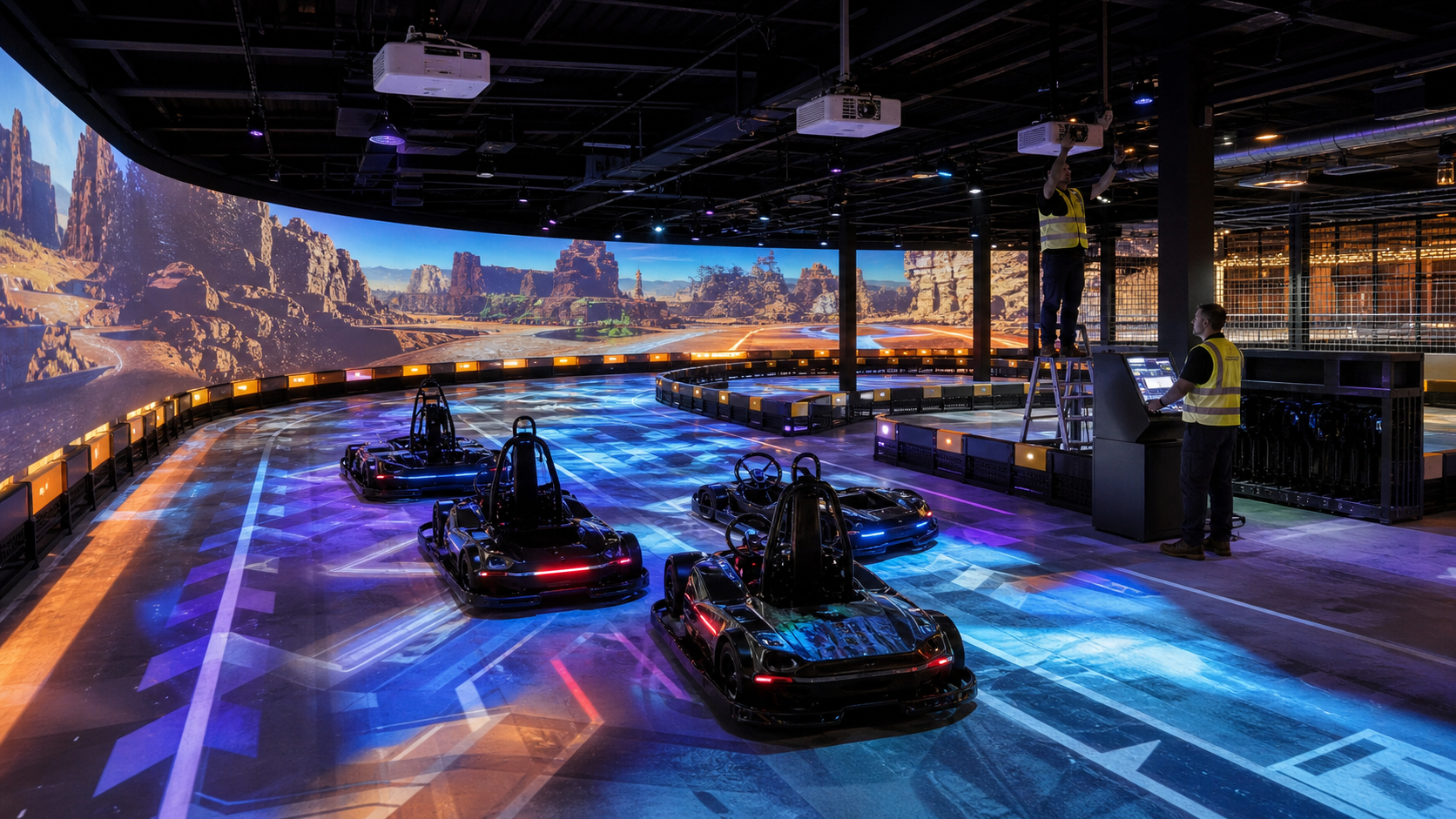
An immersive karting arena combines real electric vehicles with projection mapping, position tracking, game software, sound, and live scoring. Unlike a conventional track, it can change themes and game modes without rebuilding the physical venue. However, a successful project requires more than buying projectors. Operators must plan the vehicles, play area, ceiling, lighting, safety barriers, control system, charging zone, and content as one complete attraction.
If you are still comparing the concept with a traditional setup, first read our guide to how projection mapping works in karting and bumper car arenas.
What Equipment Does an Immersive Karting Arena Need?
First, the system needs physical vehicles and a protected driving area. It then adds floor and wall projection, vehicle positioning, game software, audio, and an operator console. Each component must communicate with the others so that a vehicle can trigger digital targets, power-ups, scoring zones, and visual effects in real time.
The table below shows an example configuration from the OneCraze Interactive Karting and Bumper Car Game Center. The final specification should always match the venue rather than copy a standard package without a site survey.
| System component | Example configuration | Main purpose |
|---|---|---|
| Wall projectors | 6 units, 5,300 lumens, 1920 × 1200 | Create panoramic scenery and display game information |
| Floor projectors | 6 units, 5,000 lumens, 1920 × 1200 | Display tracks, targets, power-ups, and scoring zones |
| Positioning devices | 5 units | Track vehicle location and connect movement with game events |
| Electric vehicles | 4 karts | Provide the physical driving experience |
| Control computer | Computer and game server | Run visuals, scoring, tracking, and session logic |
| Touch controller | Integrated touch console | Select games and manage daily sessions |
| Game software | Included | Provide themes, rules, multiplayer modes, and feedback |
In addition, the project needs protected projector mounts, audio equipment, networking, power distribution, charging facilities, safety barriers, and maintenance access. Operators can compare other interactive entertainment systems when planning a larger attraction mix.
How Much Space and Ceiling Height Are Required?
There is no responsible one-size-fits-all area recommendation. Vehicle dimensions, turning radius, player capacity, game rules, barrier clearance, projector throw ratio, and local safety requirements all affect the final footprint. Therefore, OneCraze should review the floor plan before recommending a system size.
Venue information required for layout planning
| Planning item | Information to provide |
|---|---|
| Clear floor dimensions | Length, width, columns, doors, and fixed obstacles |
| Ceiling conditions | Clear height, beams, pipes, lights, and mounting points |
| Floor surface | Material, levelness, color, reflectivity, and load capacity |
| Ambient light | Windows, skylights, existing fixtures, and blackout options |
| Vehicle plan | Vehicle model, dimensions, quantity, and turning radius |
| Guest flow | Entrance, exit, queue, briefing, spectator, and party areas |
| Operations | Charging, storage, maintenance, control, and staff access |
| Safety | Barrier zones, emergency exits, fire access, and local rules |
Projector placement matters as much as floor area. For example, a low ceiling or large structural beam can block projection coverage and create shadows. Meanwhile, uncontrolled daylight can reduce image contrast. A site survey allows the design team to choose projector brightness, lens ratio, mounting positions, and image overlap correctly. For a closer look at the projection layer, see the OneCraze indoor floor projection mapping system.
How Much Does an Immersive Karting System Cost?
The total cost depends on the complete project scope, so a single online price can be misleading. A retrofit that keeps existing vehicles and barriers will have a different budget from a turnkey venue that needs a new fleet, charging equipment, projection hardware, tracking, content, construction, and installation.
| Cost category | Main variables |
|---|---|
| Vehicles | Model, quantity, batteries, chargers, spare parts, and speed control |
| Projection | Number of surfaces, brightness, resolution, lenses, and mounting hardware |
| Tracking | Arena coverage, vehicle quantity, accuracy, and integration requirements |
| Software | Number of games, custom themes, scoring, languages, and future updates |
| Venue work | Floor treatment, barriers, electrical work, network, lighting, and audio |
| Services | Design, calibration, installation support, training, warranty, and shipping |
Consequently, buyers should compare the scope behind each quotation rather than compare only the headline price. Ask whether the proposal includes software licenses, calibration, spare parts, operator training, technical documentation, content updates, and after-sales support. This approach prevents a low equipment price from becoming a high operating cost later.
Should You Build a New Arena or Upgrade an Existing Venue?
An existing indoor karting or bumper car venue may already have usable vehicles, barriers, electrical infrastructure, and guest facilities. In that case, a projection and tracking retrofit can modernize the experience while preserving part of the original investment. However, the technical team must test the existing equipment before confirming compatibility.
| Decision factor | New arena | Existing venue upgrade |
|---|---|---|
| Layout freedom | High | Limited by the current floor plan and structures |
| Equipment choice | Designed as one integrated system | Must connect with existing vehicles and controls |
| Construction scope | Usually larger | Can be smaller if the venue is suitable |
| Installation risk | Easier to plan from drawings | Requires a detailed compatibility survey |
| Best for | New FECs and purpose-built attractions | Operators refreshing an established venue |
Moreover, a retrofit does not mean simply hanging projectors above the track. The designer must protect the equipment from impacts, eliminate tracking blind spots, control ambient light, and keep projected game zones aligned with the physical barriers. Browse OneCraze’s custom project portfolio for examples of venue-specific multimedia planning.

How Does the Installation Process Work?
The installation timeline depends on site readiness, customization, shipping, and commissioning. Instead of promising a fixed number of days before reviewing the venue, the project team should divide the work into clear stages.
- Requirement review: Confirm the audience, vehicle quantity, game style, capacity, and business goals.
- Site survey: Collect drawings, measurements, photos, videos, lighting details, and electrical information.
- System design: Plan barriers, projection coverage, tracking zones, control points, audio, and cable routes.
- Content configuration: Select standard games or develop custom themes, rules, branding, and languages.
- On-site preparation: Complete the floor, power, network, ceiling mounts, lighting control, and safety work.
- Installation and calibration: Install hardware, align projections, configure tracking, and connect game logic.
- Testing and training: Test every vehicle and game mode, train operators, and document daily procedures.
Possibly. OneCraze must review the vehicle dimensions, control system, speed, power method, turning radius, and tracking compatibility before confirming reuse.
No. The system projects the digital environment onto the physical floor and walls, so players and spectators can see the same experience without wearing headsets.
Yes. Software-based content can support different racing, collection, team, and challenge modes. Confirm the included game library, update policy, and custom-content options in the quotation.