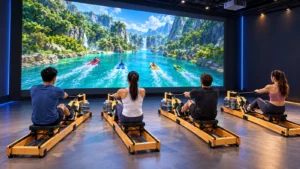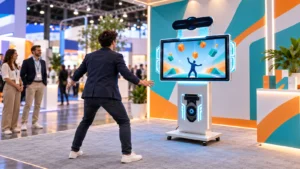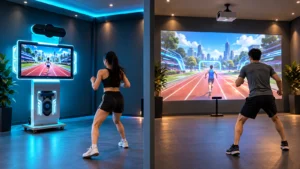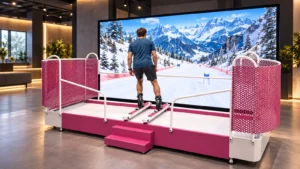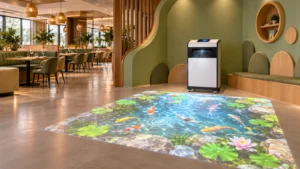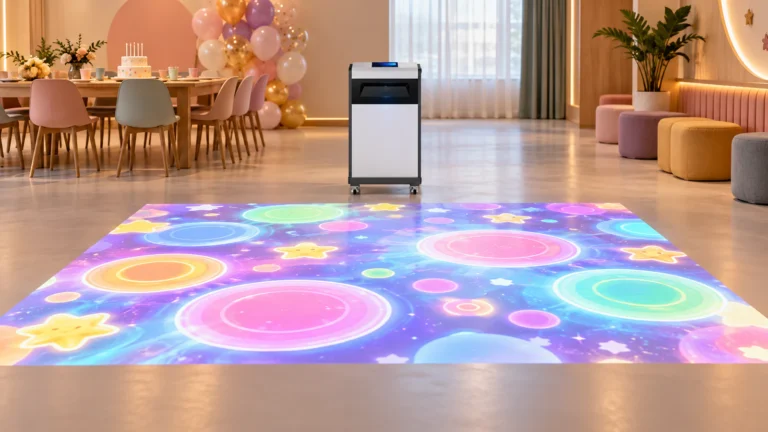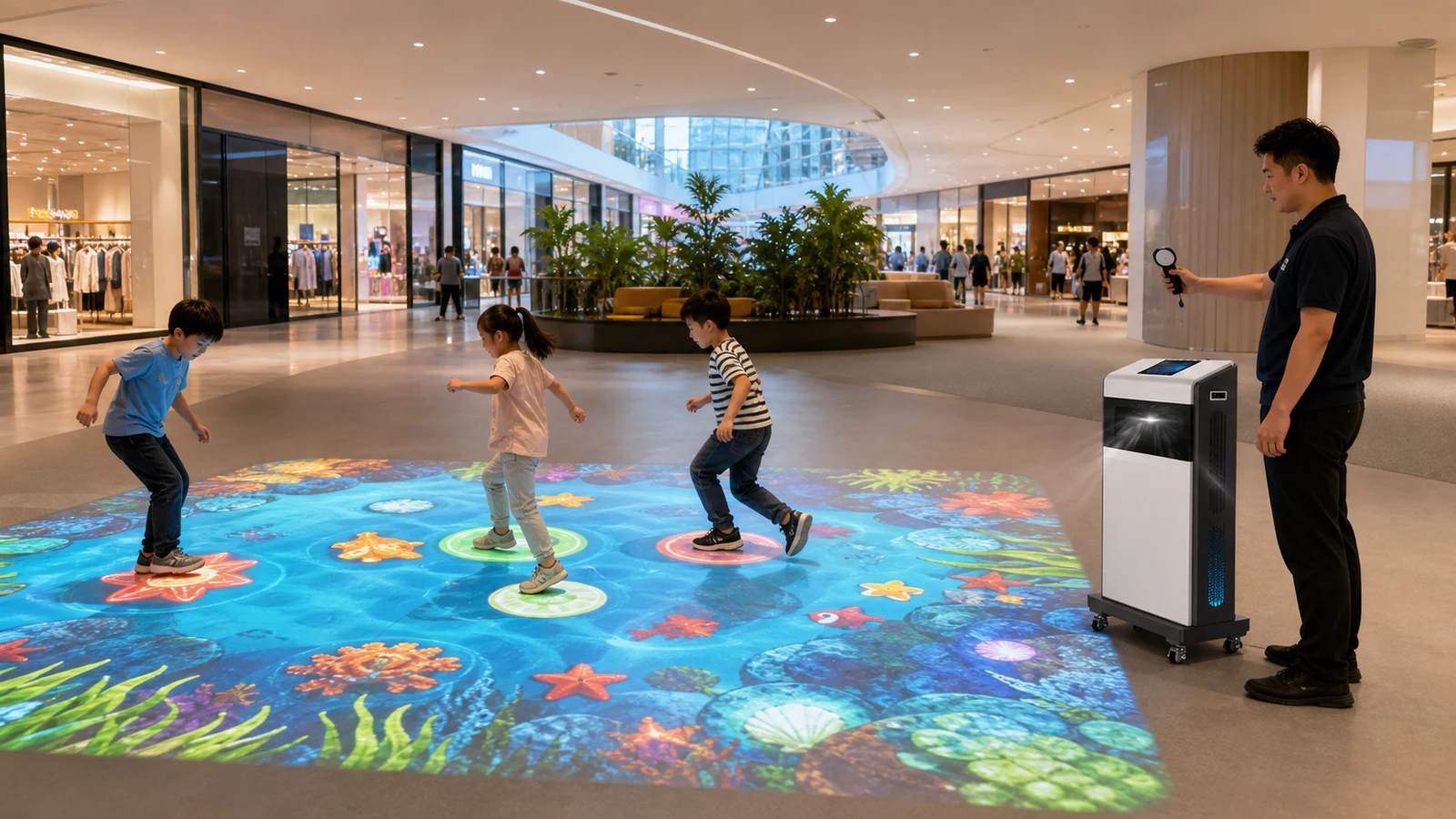
The OneCraze Mobile Interactive Floor All-in-One currently lists a 4,000-lumen laser projector, 1920 × 1080 maximum resolution and a 0.233:1 throw ratio. Because the page does not label the brightness as ANSI or ISO lumens, the final quotation should identify the exact projector model and its manufacturer-rated measurement standard.
When Is a 4,000-Lumen Interactive Floor Projector Bright Enough?
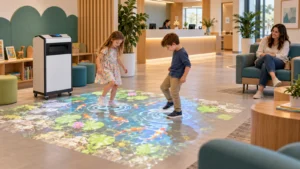
In a controlled indoor zone, 4,000 lumens Interactive Floor Projector can produce a colorful and usable floor image. A children’s play corner away from windows, for example, places fewer demands on the projector than an open atrium at midday.
A 4,000-lumen system is more likely to work when:
- The projected image is small or medium rather than oversized
- The floor is light-colored, matte and clean
- Direct sunlight does not cross the play area
- Nearby downlights can be dimmed or redirected
- The content uses bright colors and clear targets
- The projector is new, correctly focused and operating at full output
In contrast, the same projector may look weak when the venue enlarges the image, uses a dark polished floor or surrounds the attraction with LED displays. Projected black is especially vulnerable because a projector cannot remove light already falling on the floor.
For buyers whose venue has carpet, tile or dark flooring, the OneCraze guide to interactive floor projectors on carpet, tile and dark floors explains when a matte projection mat can improve contrast.
Why Does “4,000 Lumens” Not Always Mean the Same Thing?
Projector listings may use ANSI lumens, ISO lumens, LED lumens, light-source lumens or an unspecified lumen figure. These values are not automatically interchangeable. Consequently, two products both advertised as “4,000 lumens” may deliver different visible results.
Before comparing quotations, buyers should request:
- Projector brand and complete model number
- Published ANSI or ISO brightness value
- White brightness and color brightness, when available
- Native resolution and aspect ratio
- Laser, lamp or LED light source
- Throw ratio and approved operating orientation
- Normal and economy mode brightness
- Light-source life and maintenance schedule
Epson’s official projector brightness guide explains that room conditions determine the required output and recommends reviewing both white and color brightness. Similarly, BenQ’s guide to ANSI lumens and projector brightness units notes that ambient light, image size and color accuracy affect perceived brightness.
How Do Mall Lighting and Image Size Affect Floor Projection?
The following matrix is a planning guide, not a performance guarantee:
| Mall condition | 4,000-lumen outlook | Main risk | Recommended action |
|---|---|---|---|
| Indoor kids’ corner with controlled lights | Often workable | Floor pattern or local glare | Test the final image size on the actual floor |
| Enclosed FEC away from windows | Usually workable | Oversized projection | Keep the image within the tested specification |
| Retail corridor with strong downlights | Conditional | Reduced contrast | Redirect lights or use a light matte surface |
| Atrium with indirect daylight | High risk | Washed-out colors at midday | Measure lux and test a higher-output projector |
| Glass entrance or direct sun | Usually unsuitable | Sunlight overwhelms projection | Relocate, shade or use another display technology |
| Temporary night event | Often workable | Changing setup and calibration | Mark positions and repeat the test after moving |
For permanent amusement installations, buyers can review the wider planning questions in the OneCraze guide to interactive floor projection for FECs. Meanwhile, venues that cannot install overhead equipment can compare a mobile layout in the article on interactive floor projection without ceiling mounting.
Should the Buyer Choose 4,000, 5,000 or 7,000 Lumens?
Use the following ranges only for early configuration discussions. The manufacturer must still test the exact projector, image size and venue conditions.
| Nominal projector range | Typical starting point | Best suited to | Important limitation |
|---|---|---|---|
| Around 3,000 lumens | Controlled, compact indoor image | Small classrooms and dim activity rooms | Limited tolerance for bright light or large images |
| Around 4,000 lumens | Standard commercial indoor system | FEC zones, schools and controlled mall areas | Requires careful floor and lighting assessment |
| Around 5,000–6,000 lumens | Brighter or larger indoor image | Retail corridors, museums and larger play zones | Still needs protection from direct daylight |
| 7,000 lumens and above | Demanding large indoor installations | Atriums, exhibition halls and multi-purpose venues | Higher cost does not guarantee daylight visibility |
The OneCraze SAIO Interactive Floor Mapping All-in-One provides an integrated format for permanent or semi-permanent commercial operation. For a smaller education and fitness application, buyers can also inspect the Mini Sports Floor Interactive All-in-One SAIO 2.0.
How Can a Mall Improve Visibility Without Replacing the Projector?
Before purchasing a higher-output projector, the venue can often improve the environment around the attraction. These changes may cost less and produce a more consistent result.
The operator can also:
- Use a light-gray or white matte projection surface
- Reduce the projected image area
- Select games with bright backgrounds and bold targets
- Avoid very dark scenes during peak daylight hours
- Clean the projector lens and service filters as specified
- Lock the machine or mount in a repeatable position
- Store separate calibration settings for different operating zones
The OneCraze mobile interactive floor projector specification and FAT guide provides additional checks for image geometry, radar tracking, multiplayer use and repeatable setup. These tests matter because a bright image alone does not guarantee accurate interaction.
How Should the Factory Reproduce the Mall Lighting Test?
A dark factory demonstration cannot prove that a 4,000-lumen system will work in a shopping mall. Instead, the buyer and supplier should agree on a measurable test before shipment.
The buyer should send:
- Floor-level lux readings at several times of day
- Wide photos and a continuous video of the proposed area
- Floor material, color and finish
- Required projection width and height
- Distance from windows, spotlights and LED screens
- Expected operating schedule and player count
During factory acceptance testing, the supplier should reproduce the agreed illuminance as closely as practical. The team should then record the image with the ordered projector, selected game, final image size and comparable floor sample.
A useful FAT sequence is:
- Verify the projector model and published brightness specification.
- Measure ambient lux at the test surface.
- Measure the visible image width and height.
- Record bright, medium and dark game scenes.
- Film the image from player and visitor viewing positions.
- Test tracking at the center, corners and edges.
- Repeat the test after at least 30 minutes of operation.
For mobile equipment, the factory should also move and reposition the cabinet before repeating calibration. This confirms whether staff can reproduce the approved result after relocation.
It can be enough for a controlled indoor area with a moderate image size and light matte floor. However, the venue should measure ambient lux and test the exact projector because bright retail lighting and daylight can reduce contrast.
Not necessarily. “Lumens” without a named test method may describe a different measurement. Request the exact projector model and manufacturer datasheet before comparing systems.
It is unlikely to remain vivid if direct sunlight reaches the floor. Relocating the attraction, adding effective shade or selecting another display method may provide a more reliable result.
Request a Shopping Mall Brightness Test
OneCraze supplies mobile and integrated interactive floor projection systems for shopping malls, FECs, schools, museums and commercial attractions.
Contact OneCraze with your floor-level lux readings, room photos, floor material, required image size, game type and order quantity. The team can recommend a suitable projector configuration and prepare a pre-shipment brightness and interaction test plan.