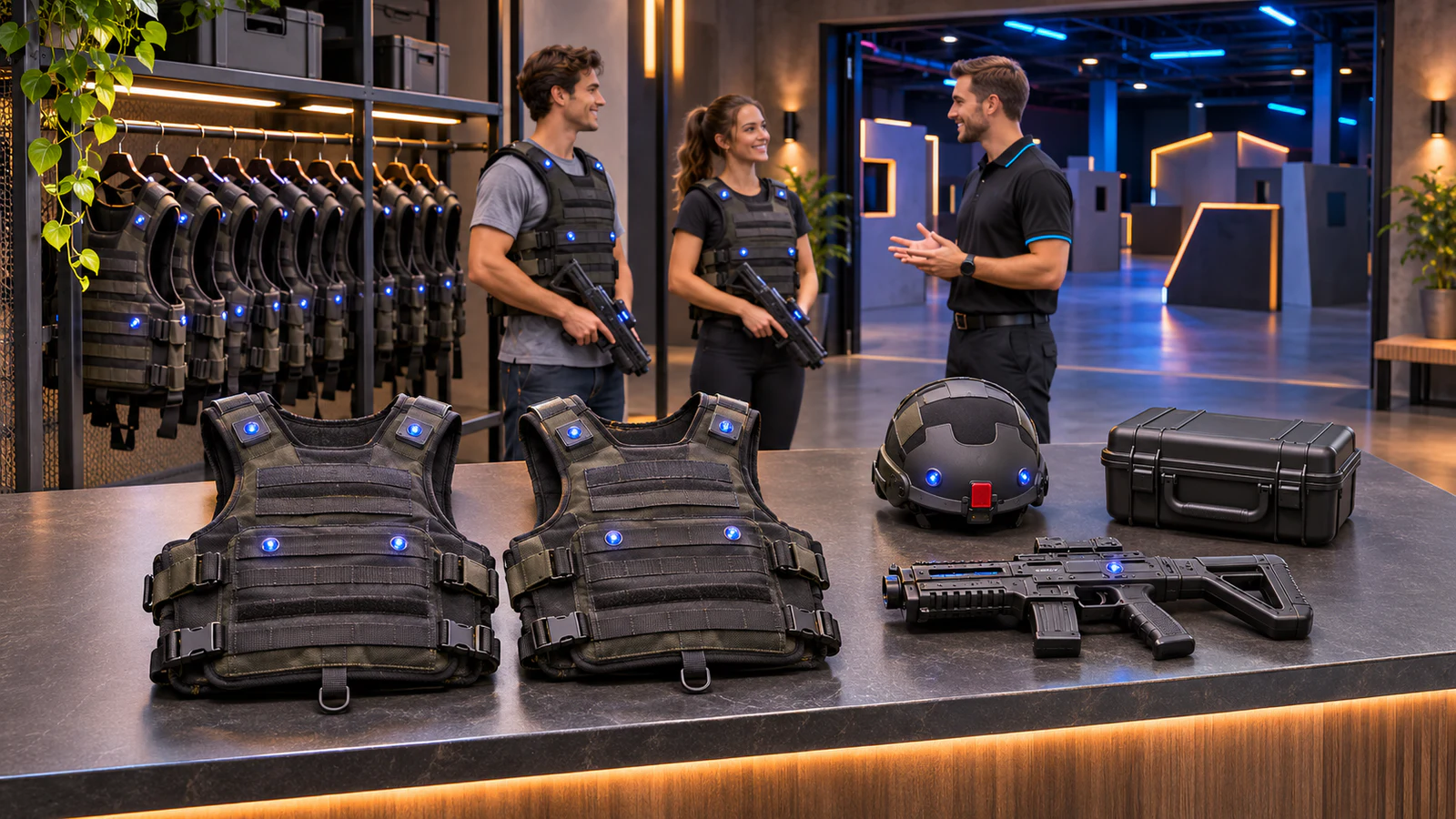
OneCraze’s laser tag gun and vest set provides a starting point for this discussion. However, a product listing is not a project-specific bill of materials. Before ordering, confirm the exact models, quantities, software functions and installation responsibilities in writing.
Choose a Business System, Not Just a Gun and Vest Set
Buyers may search for a professional laser tag system, commercial laser tag equipment or laser tag equipment for business. These phrases describe similar purchasing needs, but they do not establish a consistent package specification.
For a commercial venue, evaluate the complete operating cycle: staff issue equipment, assign teams, explain the game, start the session, review results and prepare the next group. A convincing demonstration should show that sequence rather than only a player registering a hit.
Start by defining:
- Your intended venue: a permanent arena, an existing entertainment center or a mobile event operation.
- The target player group and equipment fit requirements.
- The number of players participating simultaneously.
- The staff tasks required before, during and after each game.
If laser tag will join other attractions, review your wider sport-themed entertainment center equipment plan. The briefing area, equipment return point and queue need to work with the rest of the venue.
Put the Complete Laser Tag Equipment Package into One Table
OneCraze’s published laser sensing equipment configuration lists player equipment alongside charging accessories, carrying bags, spare items and a manual. Use that as a discussion reference, then request a dated configuration for your order.
The following table is a purchasing checklist, not a statement that every item comes standard.
| Package area | What the quotation should identify | What to verify before ordering |
|---|---|---|
| Player kits | Tagger, vest and any helmet or additional sensor | Model, quantity, fit, weight and supplied accessories |
| Game control | Controller, operator device and software | Included game modes, team assignment and session reset |
| Scoring | Player results and any separate display equipment | Where results appear and whether external screens are included |
| Charging | Batteries, approved chargers and charging connections | Simultaneous charging capacity, recharge procedure and power requirements |
| Storage and transport | Bags, cases, racks or other protection | Items supplied versus storage the venue must provide |
| Service package | Spare components, manuals and training | Replacement process, part prices and support responsibilities |

Separate Player Capacity from Equipment Inventory
Twenty player kits do not automatically establish a suitable 20-player arena. The room layout, player movement, staffing and demonstrated system capacity also matter. Likewise, owning exactly enough kits for one session leaves no reserve when equipment needs attention.
Plan the operating stock
Ask the supplier to separate the quotation into active player kits, any charging rotation stock and a maintenance reserve. Some items may serve both reserve roles, so agree the actual inventory rather than adding arbitrary percentages.
Next, check battery performance under representative use. Request the test conditions, recharge time, low-battery warning behavior and replacement procedure. Do not convert a headline battery-life figure into a guaranteed number of sessions.
For example, a venue targeting 20 simultaneous players should request a demonstrated 20-player configuration and separately priced reserve options. This is a procurement example, not a recommendation that every room should accommodate 20 players.
Define Where the Equipment Package Ends and the Arena Begins
A laser tag arena solution may involve several contractors. Therefore, separate the equipment supplier’s responsibilities from local room preparation before comparing prices.
Ask who provides:
- Arena layout, barriers, finishes and cable routes.
- Reception, briefing, equipment storage and charging areas.
- Electrical and network preparation, if required by the selected system.
- Installation, setup, staff training and opening support.
- Local site review and any required approvals.
OneCraze’s hardware-only versus turnkey quotation guide addresses projection projects, but its scope-comparison approach also helps here: compare included work, exclusions and delivery responsibilities, not just the headline price.
Confirm software and language scope separately
Request the commercial license terms, update arrangements, recovery procedure and behavior without an internet connection. If you need translated prompts or operator menus, list the required languages and screens. The questions in our multilingual software planning guide can inform that brief; they do not establish which languages a laser tag model supports.
Similarly, do not assume a shared booking or scoring platform connects every attraction in the OneCraze equipment catalog. Any integration needs its own confirmed scope.
Ask the Supplier to Demonstrate a Full Operating Cycle
Before shipment, agree a test using the ordered hardware and software configuration. Ask the laser tag equipment supplier to show:
- Player assignment, team setup and a complete session.
- Hit registration and scoring with the agreed simultaneous player count.
- End-of-game results followed by preparation for the next group.
- Recovery when a player device disconnects or becomes unavailable.
- Replacement of a player kit and the approved charging procedure.
Record the configuration, test conditions and unresolved issues. The documentation principles in our factory acceptance test guide are useful, although laser tag requires its own test procedure rather than a projection calibration checklist.
It should identify the player equipment and everything required for the agreed operating workflow, including control, charging and software. Storage, scoring displays, spare parts and installation may be included or optional; the quotation should make that distinction explicit.
Not necessarily. An equipment package may exclude room construction, barriers, electrical work, decoration and local installation. Request separate equipment and site-work schedules before treating a proposal as turnkey.
Do not assume so. Ask for the intended operating environment, environmental limits and a demonstration under representative conditions. Transport protection also needs separate consideration for mobile operations.