what buyers should request from an interactive LED floor game manufacturer, which integrations require custom work and how to compare a hardware package with a turnkey self-service room.
What Is a Self-Service Interactive LED Floor Game System?
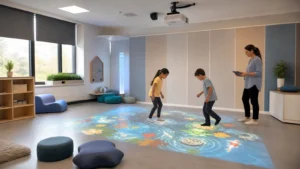
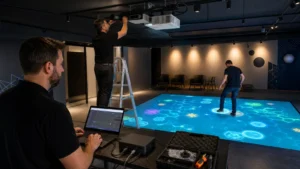
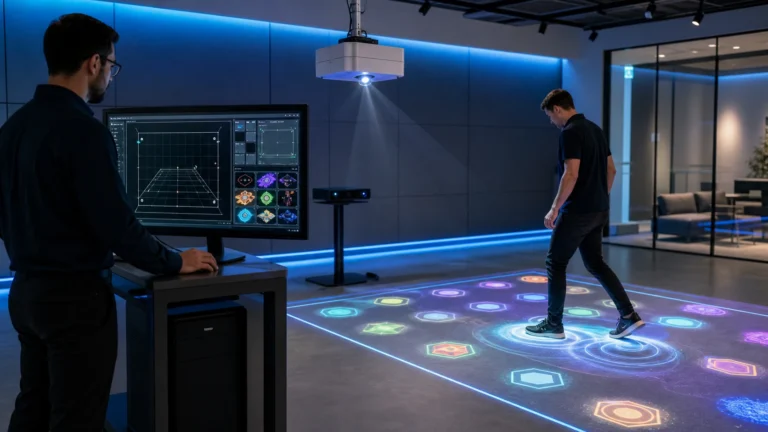
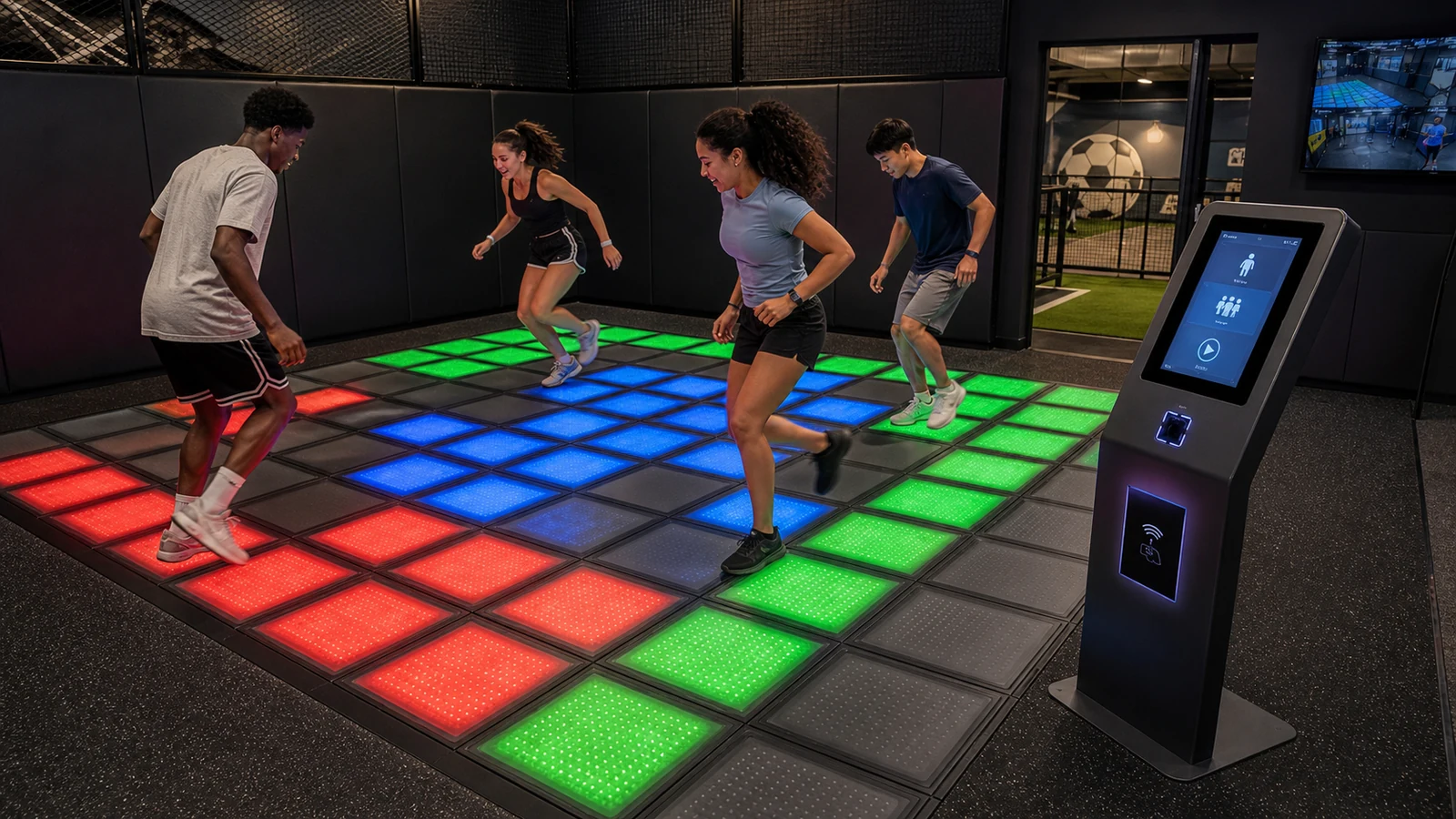
The LED grid is both the display and the player interface. Sensor-equipped tiles detect footsteps, while the game computer changes colors, sound, scores and difficulty in real time. The self-service layer sits above that core game system and manages who can enter, which session they purchased and what happens before and after play.
In practical terms, a complete system has four connected layers:
- Interactive floor: load-bearing LED tiles, step sensing, edge treatment and power distribution.
- Game engine: rules, scoring, levels, audio, player capacity and content updates.
- Guest interface: touchscreen, RFID reader, QR scanner, coin acceptor or another start device.
- Venue control: booking, membership, payment, session logs, fault alerts and staff override.
The current OneCraze Lava LED Floor Game room solution lists 300 × 300 × 75 mm capacitive tiles, one to six players, four game modes with up to 24 levels, a three-year warranty and lifetime software support. Those published details describe the game platform; a buyer should request self-service access and third-party integration as a separate, project-specific scope.
Buyers who first need to compare game mechanics, tile quantities and room planning can also read the OneCraze guide to building a commercial Floor Is Lava game room. This article focuses on the extra operating layer required for unattended or low-staff use.
How Should an Unattended LED Floor Game Session Work?
A good player flow takes only a few steps and still gives staff control when something goes wrong. First, the guest buys or receives access. Next, the reader validates the session and displays simple rules. The room checks that it is ready, starts a visible countdown and runs the purchased game time. Finally, the system shows the score, releases the room and returns to an attract screen.
Recommended guest journey
- The player books online, pays at a kiosk or receives play credit at reception.
- A QR code, RFID wristband, membership card or coin activates the session.
- The screen confirms group size, language, game and remaining credit.
- A safety message and visual tutorial appear before the door or game unlocks.
- The floor runs a countdown, game sequence and end-of-session warning.
- The system saves the permitted result, clears personal data as configured and resets.
- Staff receive an alert if the room does not reset, a tile fails or a player presses the help button.
| Start method | Best commercial use | Integration required | Question for the supplier |
|---|---|---|---|
| RFID wristband or card | FECs, trampoline parks and multi-attraction venues | Reader, membership database and credit rules | Can one wristband unlock several attractions without duplicate charging? |
| QR code | Online booking, mall pop-ups and timed sessions | Booking platform, scanner and token validation | Is each code single-use, time-limited and protected against screenshots? |
| Coin or token | Arcades and simple standalone installations | Coin acceptor, pulse input and local pricing logic | Can staff change price and free-play mode without editing the game? |
| Touchscreen package | Parties, group booking and sports centers | Kiosk UI, payment or reception validation | Can guests choose language, group size and difficulty before entry? |
| Staff-issued start | Semi-self-service pilot projects | Operator panel and session timer | Can the venue add RFID or API access later without replacing the game computer? |
Which API, Payment and White-Label Integrations Should Buyers Request?
Integration requirements should describe specific events and data, not simply ask whether the product “has an API.” For example, the venue may need its booking platform to send a session ID and duration, while the game system returns start time, finish time, score and fault status. If the two suppliers do not agree on fields, authentication and retry behavior, both sides can claim compatibility without producing a working workflow.
Ask the LED floor supplier to define:
- Available API, SDK, relay, serial or dry-contact interfaces
- Commands for enable, start, pause, stop, reset and free-play mode
- Events for room ready, session active, session finished and hardware fault
- RFID, QR, coin, POS and membership platforms already tested
- Offline behavior when the internet or venue server becomes unavailable
- Role-based staff accounts, activity logs and remote-support permissions
- Data stored for players, scores and video, plus the deletion period
- Ownership of custom connectors and responsibility after either system updates
If the attraction accepts card payments directly, the payment terminal and integration should follow the venue’s compliance program. The PCI Security Standards Council publishes the payment-card security standards and supporting resources; the game supplier should not store raw card details merely to start a session.
White-label work also needs a precise content list. It may include the launcher logo, attract screen, colors, room name, game instructions, leaderboard, result page and email or QR result. Language localization is a separate task, especially when the project needs Arabic or another right-to-left interface. Buyers can use the OneCraze guide to multilingual interactive software and Arabic RTL and the guide to OEM game software and API options to prepare the requirement sheet.
How Does the LED Floor Fit a Sport-Themed Entertainment Center?
A self-service LED grid works best as one short, physical challenge within a broader attraction mix. It can deliver reaction races, memory routes, team cooperation, territory games and time attacks without requiring guests to wear a headset or learn a complex controller. Meanwhile, a visible leaderboard connects individual rounds to tournaments, parties and corporate events.
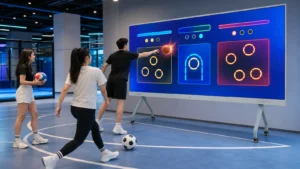
The floor should still have a defined role. A sports center that already offers basketball, football and throwing games may use the LED room as its reaction-and-agility zone. A multi-room active game venue can use it as one timed mission between wall-button, climbing, laser and ball challenges. This positioning is more credible than claiming that one grid replaces every type of sports entertainment equipment.
| Venue objective | Suitable LED floor format | Useful adjacent equipment | Operating priority |
|---|---|---|---|
| Short paid attraction | Fast one-to-six-player timed challenge | Score display and photo/result screen | Rapid reset and simple access |
| Multi-room active game center | RFID-controlled mission room | Interactive walls, laser challenges and team stations | Shared membership and central monitoring |
| Sports-themed FEC zone | Reaction, agility and team modes | Immersive sports projection and multi-sport ball wall | Consistent scoring and difficulty |
| Party or corporate package | Scheduled group tournament | Host screen, team names and leaderboard | Group management and report export |
| Mall or hotel installation | Semi-self-service compact room | Mobile floor projection or creative play systems | Supervision, sound and circulation |
What Should a Turnkey Manufacturer Include in the Quotation?
Request the following deliverables:
- Dimensioned room plan, tile layout, entrance, control point and maintenance access
- Exact tile model, sensing method, surface material, load rating and replacement procedure
- Power schedule, control diagram, network requirements and cable routes
- Game list, player capacity, languages, difficulty settings and update terms
- Kiosk or reader model, supported access methods and integration responsibility matrix
- API documentation, test environment and named acceptance cases
- Manual start, pause, emergency stop and recovery procedure
- Remote monitoring, log export, backup and offline-mode description
- Packing list, installation manual, maintenance schedule and recommended spares
- Hardware-only, integrated package and turnkey room prices shown separately
For safety planning, the owner should also determine which local amusement, electrical, fire, accessibility and building requirements apply. ASTM International’s F24 committee develops standards for amusement rides and devices, but the local authority and project team must decide which standards apply to a particular LED game room.
OneCraze can supply a core LED floor platform or discuss a wider active-entertainment solution. Buyers who already have a local integrator may prefer hardware and software with interface documentation. New operators may need a turnkey package with layout design, white-label content, remote commissioning and staff training. The OneCraze article on comparing interactive system quotations provides a practical scope-comparison method.
The supplier should also record software versions, serial numbers and configuration files so the delivered system matches the demonstrated system. For a fuller template, review the OneCraze interactive system factory acceptance test guide.
It can support self-service play when access control, player instructions, automatic reset, fault alerts and staff override are integrated. Whether the room may operate fully unattended depends on the venue layout, guest age, local requirements and the operator’s risk assessment.
Potentially, but compatibility requires interface details from both suppliers. Share the RFID type, reader protocol, membership platform, required commands and data fields before quotation. A live integration test should form part of acceptance.