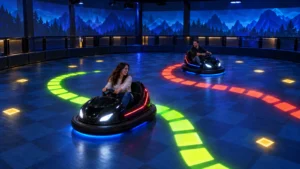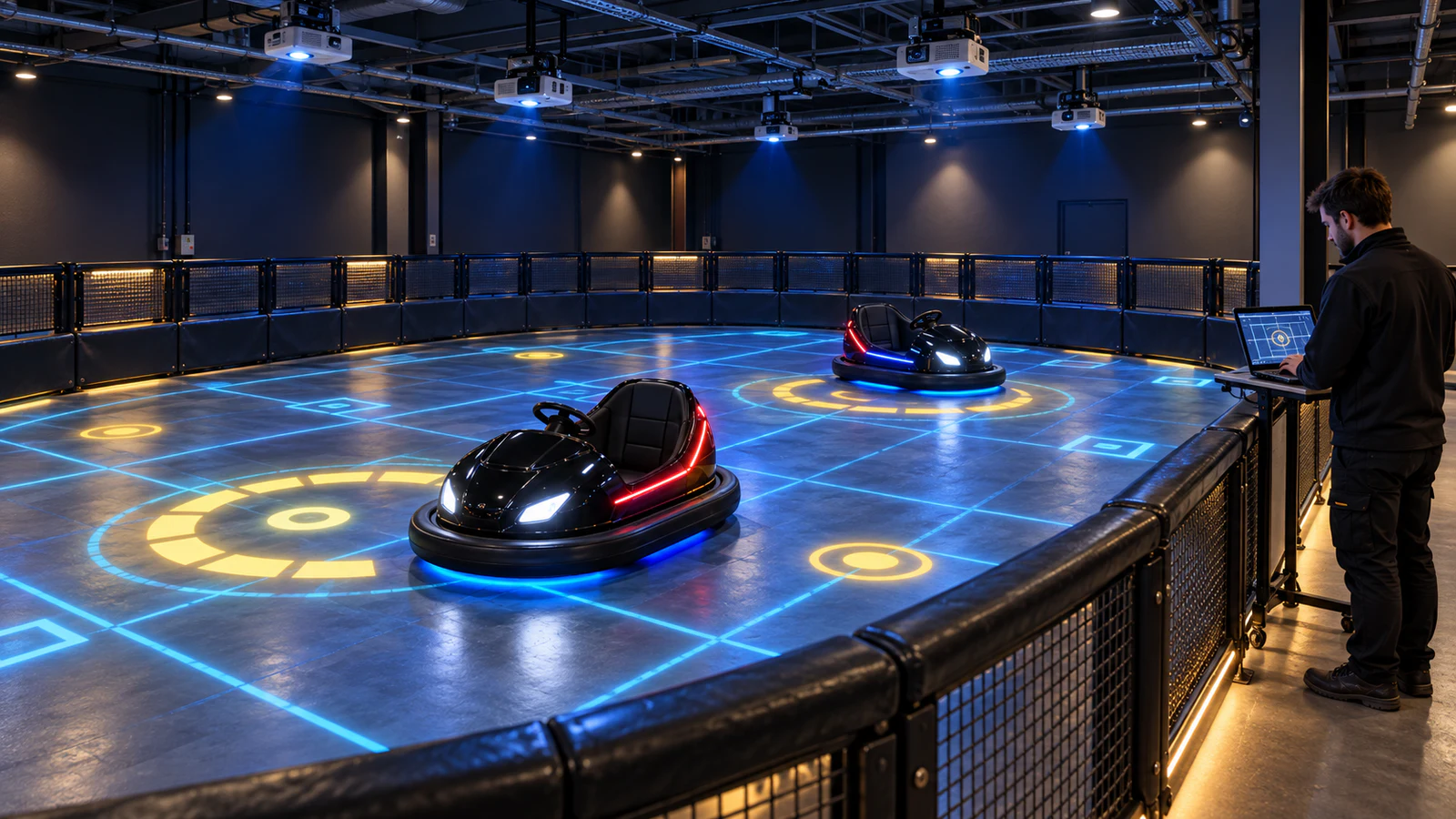
For operators considering a bumper car projection retrofit, the first decision is therefore not which projector to buy. It is whether retaining the existing fleet creates a practical, supportable attraction. Use the OneCraze interactive karting and bumper car game center as a system reference, then request an assessment of your actual equipment rather than assuming that a new-build package will fit.
Can Your Existing Bumper Cars Become Game Controllers?
An interactive game needs to connect each participating vehicle with the correct player. Depending on the proposed tracking design, this may involve additional identification hardware, markers or other integration work. The supplier must explain its method and verify compatibility with your fleet.
Start with the vehicle manufacturer, model, dimensions, power arrangement and operating condition. Then ask how the proposed system distinguishes cars when they turn, pass close together or move near the perimeter.
Importantly, position tracking and vehicle control are different functions. A system that follows a car’s location does not necessarily control its speed, detect physical impacts or communicate with its drive electronics. Do not assume that a projected effect changes how the vehicle behaves.
Our guide to how bumper car projection mapping works explains the relationship between positioning, software and projected content. For a retrofit, that relationship must work with the retained hardware—not just with the supplier’s demonstration cars.
Which Parts of the Existing Arena Can You Keep?
Treat reuse as a component-by-component decision. A working attraction may still need changes to display readable graphics, maintain tracking coverage or support new session routines.
| Existing component | Potential reuse | What needs checking |
|---|---|---|
| Bumper cars | Retain vehicles if their condition and integration are acceptable | Identification method, mounting arrangements, serviceability and manufacturer restrictions |
| Floor | Retain the surface if it suits both driving and projection | Finish, reflections, wear, vehicle requirements and any electrical function |
| Barriers and gates | Retain if suitable for the revised operating layout | Condition, access, boarding arrangements and separation from equipment |
| Projectors | Reuse only after a layout and image test | Lens, coverage, brightness, mounting position and signal compatibility |
| Sound and lighting | Retain where compatible with the game experience | Audio integration, light spill and operator control |
| Existing ride controls | Assess separately from the game computer | Stop functions, approved interfaces and responsibility for any changes |
This is a screening table, not a certification of compatibility. In particular, do not repaint or resurface a floor without checking the ride manufacturer’s requirements; some installations use the floor as part of their power system.
Once the reuse decisions are documented, the bumper car projection equipment guide can help identify the additional display, computing and positioning equipment to discuss.
Is a Visual Upgrade Enough, or Do You Need Interactive Games?
These are different project scopes, so define the intended result before requesting prices.
A visual upgrade changes the environment
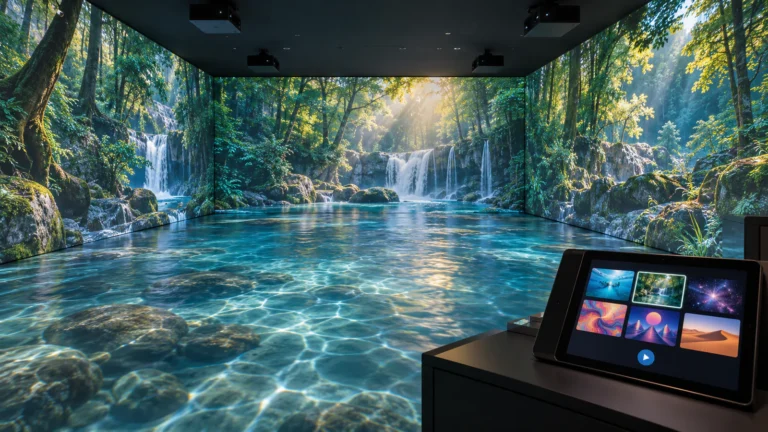
Projected scenery, animated patterns and themed backgrounds can change an arena’s appearance without responding to individual cars. This may meet a venue’s visual goals, but it should not be sold or purchased as vehicle-responsive gameplay.
An interactive upgrade changes what players do
Interactive content uses tracked movement to trigger game events. For example, the digital trails discussed in our Snake game bumper cars guide connect driving with a visible game layer. The exact scoring and collision rules still depend on the supplied software.
Consequently, ask for the required game modes by name and describe the player actions you expect. If you want collection challenges, team competition or Snake-style trails, request demonstrations of those functions with a compatible vehicle configuration. A generic animation reel cannot establish compatibility.

When Might Replacement Be Better Than a Retrofit?
Retaining equipment can reduce the amount of new hardware purchased. However, that advantage may disappear if the project requires extensive adaptation or leaves unresolved maintenance responsibilities.
Consider a replacement or partial-replacement proposal when:
- The existing cars need substantial repairs before integration can begin.
- The supplier cannot demonstrate reliable identification with the proposed fleet.
- Columns, overhead structures or lighting prevent acceptable tracking or projection coverage.
- Required modifications lack approval from the relevant equipment manufacturer.
- Multiple contractors cannot agree who will resolve combined vehicle-and-software faults.
Also compare the work needed around the attraction. Repositioning equipment, preparing mounts, installing cables and commissioning software can affect reopening even when the cars remain unchanged. The immersive karting arena planning guide helps frame these site questions.
What Should You Send for a Retrofit Assessment?
A useful inquiry gives the supplier enough information to identify uncertainty early. Send:
- Vehicle details: manufacturer, model, quantity, dimensions, power arrangement, available manuals and clear photos.
- Room information: a dimensioned floor plan, clear ceiling height, columns, overhead obstructions, gates and boarding areas.
- Site evidence: photos under normal operating lighting and a continuous video of the current attraction running.
- Project goals: desired games, simultaneous player count, equipment you hope to retain and the available installation window.
Next, request a written assessment that separates confirmed reuse, proposed modifications and unresolved tests. When reviewing the system quotation, check that each retained component has an agreed interface and support owner.
No universal compatibility should be assumed. Vehicle condition, identification, mounting options, power arrangements and software integration all require review. Approval for one model does not establish compatibility with every car in a mixed fleet.
Do not assume that a standard kit will fit your attraction. Ask the supplier to name the supported vehicles, site conditions, included software and commissioning work. A package still needs a defined installation scope even if its components arrive preconfigured.
Possibly, subject to inspection and the proposed layout. The floor must remain suitable for the vehicles as well as the image, while barriers and gates must suit the operating arrangement. A projection upgrade does not remove existing ride-maintenance or safety obligations.