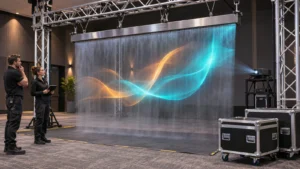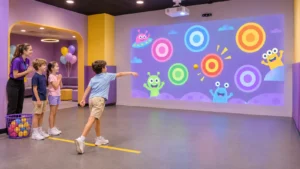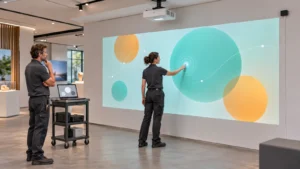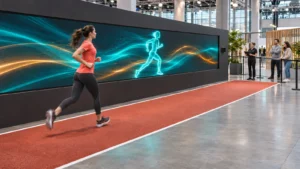
For a family entertainment center, the purchasing question is therefore not simply which technology looks brighter. It is which system supports your guests, activity format and installation conditions. OneCraze’s interactive rock climbing projection system provides a projection-based option; confirm the current hardware, content and supply scope against your project brief.
Understand What Each Type of Climbing Wall Does
The terms “smart climbing wall” and “interactive bouldering wall” describe several product categories. Start by asking what the system displays, what it detects and what happens when a participant completes an action.
Projection-Based Climbing Games
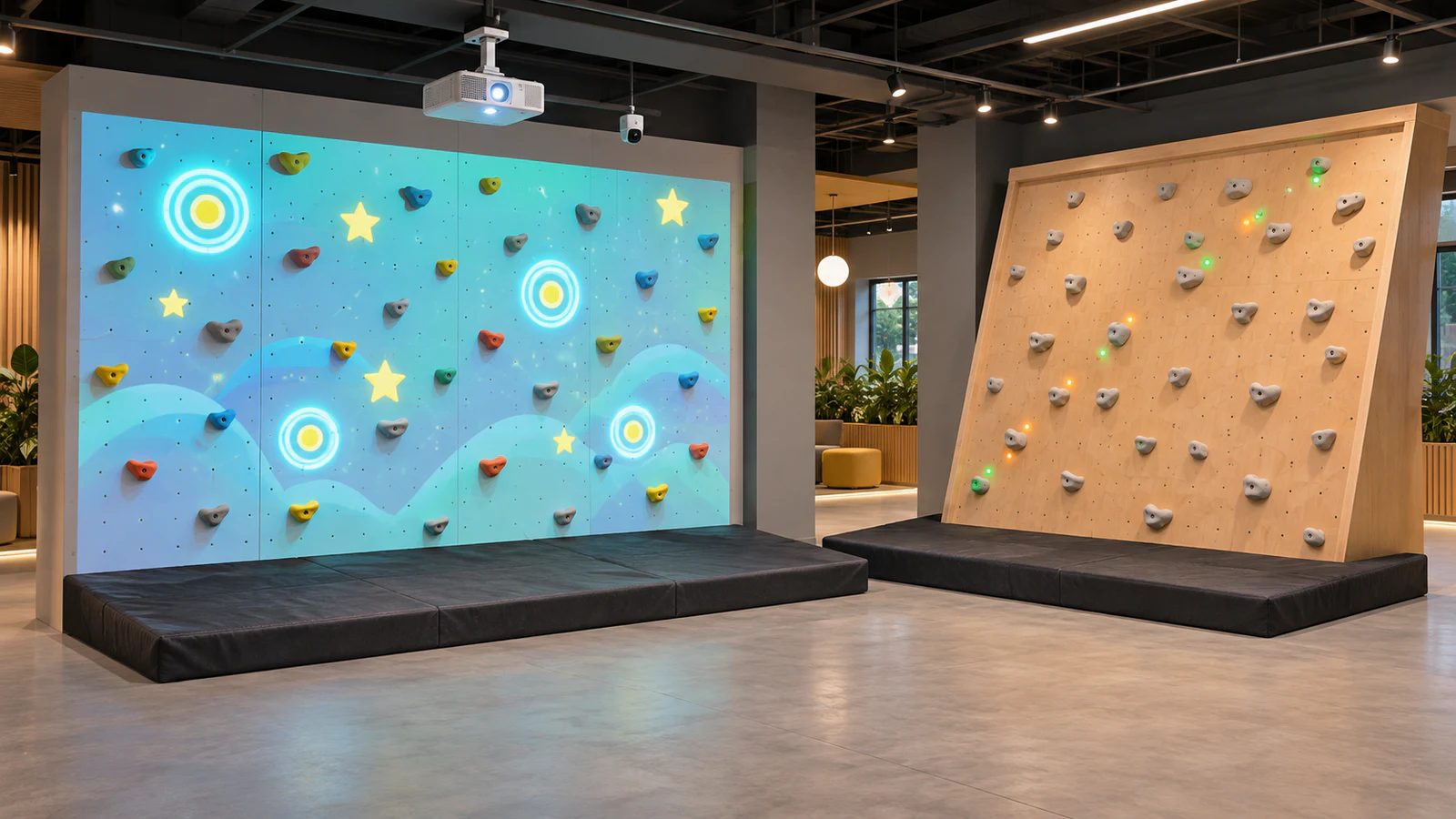
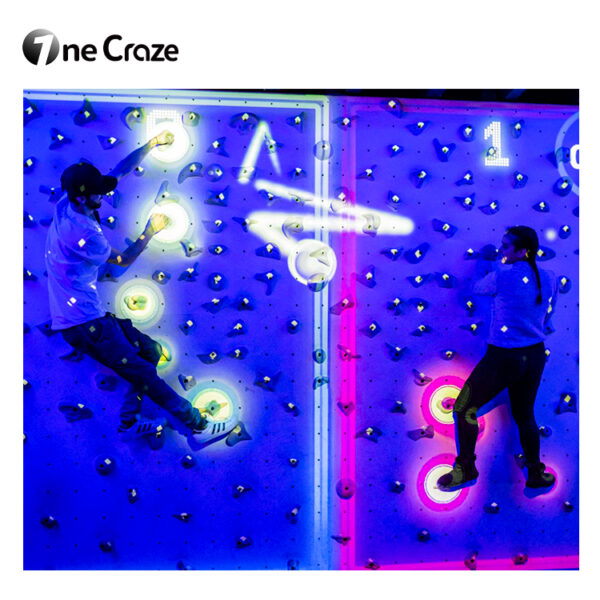
A projector places targets, animations or other game graphics on a real climbing wall. Compatible tracking equipment and software connect participant actions with the displayed content. The introduction to augmented climbing games explains this equipment combination.
Changing digital graphics can refresh the experience, but software does not change the physical difficulty of reaching a hold. Wall geometry and hold layout still matter.
LED Route Boards and Interactive Light Targets
An LED route board can illuminate a sequence of holds selected through an application. However, showing a route does not itself prove that the system detects touches or automatically verifies a completed climb.
An interactive light-target wall is another configuration: targets may register contact and trigger game responses. Buyers should verify the actual detection method rather than assuming every illuminated hold is a sensor. Likewise, projection systems can include training applications, and LED systems can include entertainment games. Compare demonstrated functions, not category labels alone.
Compare the Experience and Installation Together
Use the following table to organize supplier discussions. These are typical distinctions, not guaranteed specifications for every product.
| Buying factor | Projection climbing games | LED route board | Interactive light-target wall |
|---|---|---|---|
| Main visual element | Graphics projected across the surface | Lights identifying selected holds | Illuminated targets or buttons |
| Input to verify | Tracking of the actions required by the game | Route selection; climb logging or detection varies | Contact detection and game response |
| Content focus | Visual challenges, animations and supported games | Climbing routes and repeatable problems | Sequences, reactions and supported challenges |
| Installation checks | Projection path, wall finish, shadows and sensor view | Hold layout, LED placement and wiring access | Target mounting, wiring and service access |
| Update questions | Included games, licensing and compatibility | Route library and board-layout compatibility | Available modes and controller compatibility |
| Maintenance questions | Alignment, optics, sensors and software recovery | Lights, connections, controls and physical holds | Targets, connections, controls and mounting |
Choose Around Your Guests and Session Format
Projected climbing games are worth evaluating when animated objectives and visual feedback are central to the attraction. An LED route board may deserve closer attention when the project prioritizes repeatable climbing problems and skill practice. Interactive light targets offer another direction when the intended experience centers on reaching illuminated points.
Before choosing, describe:
- The intended participant ages and experience levels.
- Whether the activity runs as individual turns or supported group sessions.
- How staff introduce, supervise and stop the activity.
- What guests should experience during a complete turn.
Then test those requirements with the proposed software. Do not assume a multiplayer mode permits unrestricted simultaneous climbing. Approved participation, separation and supervision depend on the complete installation and operating assessment.
Assess the Existing Wall Before Buying a Retrofit Kit
An interactive climbing wall retrofit solution should begin with a survey of the physical wall. Share photographs, dimensions, panel angles, hold positions, available mounting locations and room lighting with the supplier.
For projection, evaluate whether participants can see important targets and whether the sensor can observe the required actions. Large holds, projecting volumes and climbers themselves may obstruct parts of the image or tracking view. The guide to white panels and climbing holds explains why color alone cannot determine compatibility.
For an LED upgrade, ask whether the proposed equipment requires a particular hole pattern, hold arrangement, mounting detail or access behind the panels. A standardized training-board kit may not match an arbitrary existing wall.
In either case, do not drill, repaint or alter a climbing structure without approval from the responsible manufacturer or qualified installer. Digital equipment does not replace structural assessment, appropriate landing protection, inspection or venue operating procedures.
Finally, request exact sensor information where tracking forms part of the system. The comparison of LiDAR, IR cameras and depth sensors provides background, but compatibility must be confirmed for the selected climbing application.
Compare Complete Quotations and Demonstrations
A climbing wall projector and sensor kit is not necessarily a complete climbing attraction. Before comparing suppliers, separate the digital equipment from the physical structure and on-site work.
Request an itemized proposal covering:
- Wall structure, panels, holds and landing protection, where supplied.
- Projector or lights, sensing equipment, computer and controls.
- Software, commercial-use rights and included content.
- Mounting, cabling, installation and calibration responsibilities.
- Training, replacement parts, warranty and ongoing support.
Use the quotation comparison guide to identify exclusions rather than treating the lowest equipment price as the lowest completed-project cost.
Next, agree on a representative demonstration. For projection, check visible targets and detection across the intended area. For LED systems, verify route selection or contact response as applicable. For both, test operator controls, restart behavior and the procedure after a component fault.
The factory acceptance checklist can help document digital-system testing. However, it does not replace site commissioning or the separate assessment of the climbing structure and protective provisions.

No. LED systems use physical lights, while projection systems display images from a projector. Their sensing methods, applications and installation requirements can differ substantially.
Not necessarily. Illuminating holds and recording physical contact are different functions. Ask how the proposed system confirms actions and whether any logging requires participant input.
Possibly, following a compatibility and structural review. Provide the supplier with the wall geometry, hold arrangement, lighting conditions and installation access before ordering an upgrade.