What Are Interactive Climbing Wall Games?
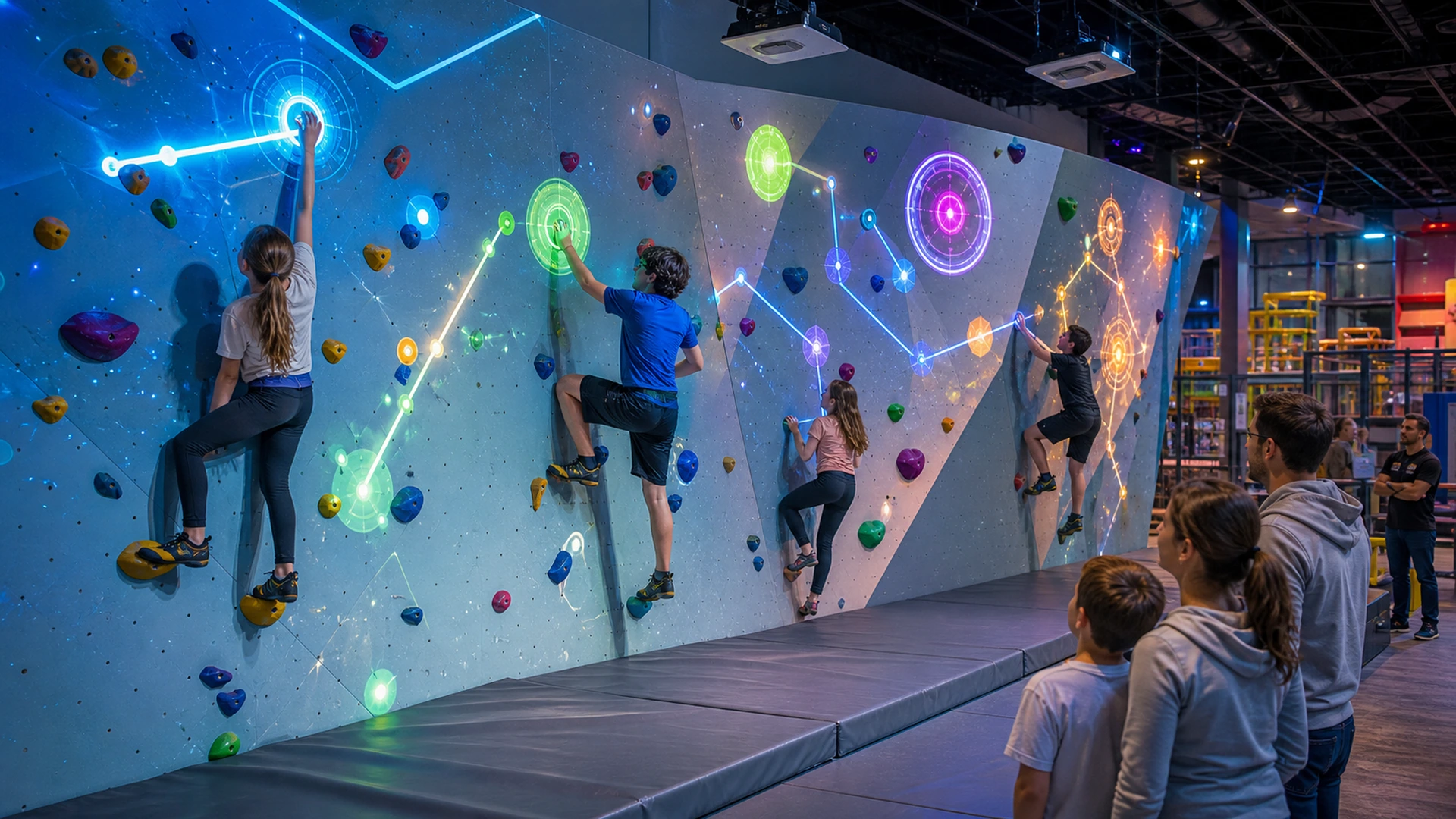
Interactive climbing wall games use projection mapping, sensors and software to make a climbing wall respond to the player’s movement. The system projects digital routes, targets, animations or game tasks onto the wall. Then sensors track the climber’s position or actions, and the software provides real-time visual and scoring feedback.
This format is especially useful for kids and first-time climbers because it gives them a clear goal. They are not only climbing upward; they are chasing stars, touching light zones, escaping digital hazards or competing in a timed challenge. As a result, the wall becomes both a physical activity and a game system.
How Does a Rock Climbing Projection System Work?
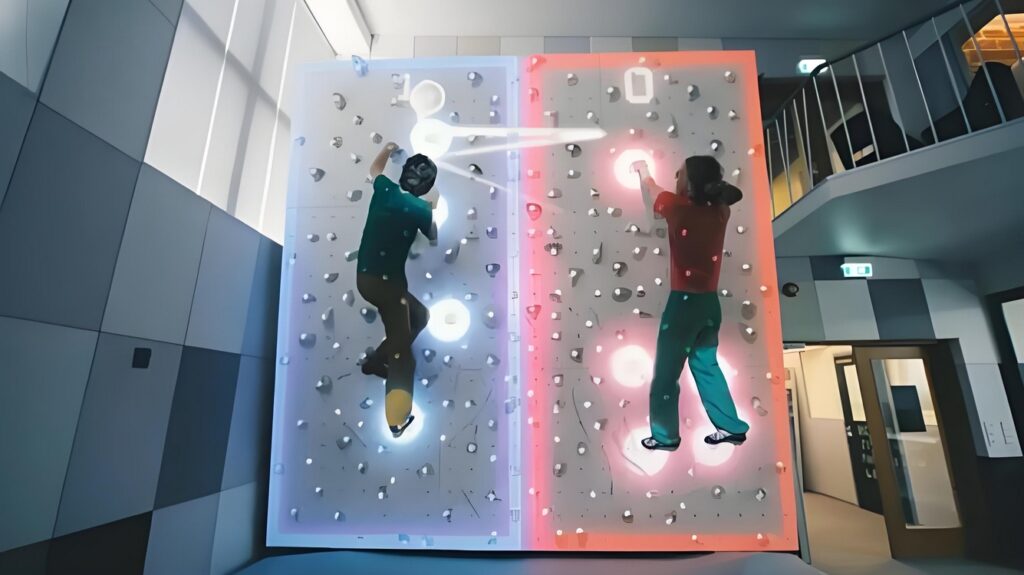
A complete rock climbing projection system normally includes a climbing wall, projector, sensor, computer, game software, audio feedback and calibration tools. The projector displays the game scene on the wall, while the sensor detects climbing movement. The software then links movement to game results, such as scoring, route changes or visual effects.
| System part | Main role | Buying note |
|---|---|---|
| Climbing wall | Provides the physical climbing surface | Must be stable, safe and suitable for the target age group |
| Projector | Displays game scenes and climbing targets | Brightness, resolution and throw ratio affect image quality |
| Sensor | Tracks player movement or interaction | Accurate tracking is essential for smooth gameplay |
| Computer | Runs the software and processes input | Commercial venues need stable hardware for daily operation |
| Game software | Provides scenes, rules, levels and scoring | More game modes improve repeat play value |
| Calibration tools | Align projected images with the wall | Good calibration prevents mismatch between visuals and holds |
| Audio feedback | Adds timing cues, scores and effects | Sound makes hits, wins and countdowns easier to understand |
According to the OneCraze product details, its interactive rock climbing system can include 12 game scenes, projector hardware, sensor tracking and a computer configuration for running the software. The exact project design should still match the wall size, room layout and business model.
Best Venues for Interactive Climbing Wall Games
Interactive climbing walls work best in venues where guests already expect active play. The attraction can support children, teens, family groups and sports training users if the content difficulty is designed correctly.
| Venue type | Best use | Operator benefit |
|---|---|---|
| Indoor playground | Kids climbing games, target challenges and simple missions | Makes climbing easier to understand and more exciting |
| Family entertainment center | Timed games, multiplayer scores and premium activity zones | Adds a replayable attraction for parties and group bookings |
| School gym | Coordination training, PE challenges and active learning | Encourages movement and problem-solving |
| Climbing gym | Skill games, route variation and beginner engagement | Adds a gamified layer to traditional climbing |
| Sports center | Reaction training and fitness challenges | Supports active training with visual feedback |
| Mall activity zone | Compact climbing attraction with strong visual appeal | Attracts passing families and increases dwell time |
If your venue is building a larger active entertainment mix, you can also compare climbing wall projection with interactive gym wall games for schools and FECs and interactive trampoline games.
Interactive Climbing Wall vs Traditional Climbing Wall
A traditional climbing wall is still valuable for physical skill and training. However, interactive projection adds digital goals, visual storytelling and game-based feedback. This can make the attraction more approachable for younger players and more marketable for commercial venues.
| Comparison point | Traditional climbing wall | Interactive climbing wall games |
|---|---|---|
| Main experience | Physical climbing route | Climbing plus digital missions and scoring |
| Replay value | Depends on route changes and hold layout | Software scenes and game modes can refresh the experience |
| Player motivation | Reach the top or complete a route | Hit targets, beat time, collect points or finish a mission |
| Best audience | Climbers and fitness users | Kids, families, beginners, schools and FEC guests |
| Staff operation | Route monitoring and safety briefing | Safety briefing plus game mode selection and system checks |
| Marketing angle | Fitness, challenge and adventure | Augmented climbing, active gaming and immersive play |
Therefore, the interactive system should not be seen as a gimmick. It gives operators a way to package climbing as a game, a party activity, a training tool or a premium attraction.
Game Ideas for an Augmented Climbing Wall
The best climbing wall games should be easy to understand from the ground. Players need to know where to climb, what to touch and how to score before they start. For younger children, colorful targets and simple missions work better than complex rules.
| Game idea | How it works | Best for |
|---|---|---|
| Target climb | Players climb to touch projected targets in sequence | Kids play centers and beginner zones |
| Timed challenge | Players complete a route before time runs out | FECs, gyms and party competitions |
| Color match | Players climb toward matching colors or symbols | Schools and younger children |
| Monster escape | Players avoid projected obstacles while climbing | Indoor playgrounds and themed attractions |
| Treasure hunt | Players collect digital items on the wall | Family entertainment centers |
| Two-player race | Players compete on separate wall zones | Group events and birthday parties |
| Training mode | Players follow projected movement prompts | Climbing gyms and sports training rooms |
The key is to balance excitement with safety. The game should encourage movement, but it should not push players into unsafe speed or poor climbing choices.
Setup and Installation Checklist
Before installing an interactive climbing wall system, review the wall dimensions, ceiling height, projector position, sensor view, ambient light, safety padding and maintenance access. Projection quality depends heavily on throw ratio, image alignment and wall surface conditions. OneCraze has also published a guide on the ideal image projection ratio for interactive rock climbing walls, which is useful during layout planning.
| Checklist item | What to confirm |
|---|---|
| Wall size | Width, height, hold layout and available projection area |
| Wall safety | Structure, padding, fall zone and age suitability |
| Projector position | Throw distance, brightness, mounting height and shadow control |
| Sensor placement | Clear tracking view without blocked zones |
| Lighting | Controlled light so projected targets remain visible |
| Calibration | Accurate alignment between visuals and climbing surface |
| Staff access | Easy startup, game switching and emergency stop process |
| Maintenance | Reachable projector, sensor, computer and cables |
The installation should also consider how guests queue, where parents watch and how staff brief players. For children’s venues, safety flow is just as important as the visual effect.
Buying Factors and Cost Considerations
The cost of an interactive climbing wall game depends on the wall size, projector brightness, sensor type, software package, installation complexity and customization. A compact children’s wall will not require the same budget as a larger commercial climbing attraction with custom scenes and multi-player modes.
| Buying factor | Why it matters | Question to ask |
|---|---|---|
| Game scenes | Content drives repeat play | How many game modes are included? |
| Sensor accuracy | Tracking affects responsiveness | Can it track movement reliably on the climbing surface? |
| Projection quality | Visual clarity affects user experience | Is the projector bright enough for the venue lighting? |
| Calibration process | Poor alignment weakens gameplay | How easy is setup and recalibration? |
| Safety design | Climbing has higher physical risk than floor games | Does the layout match local safety rules and supervision needs? |
| Customization | Custom themes can support branding and events | Can the supplier create new scenes or difficulty levels? |
| Support | Commercial venues need uptime | What training, warranty and remote support are included? |
For operators comparing multiple interactive projector products, the OneCraze interactive projector system products page can help you review floor, wall, climbing and sports projection options.
Yes, if the wall height, padding, game speed, supervision and difficulty level are designed for children. Simple target games, color matching and timed missions are usually easier for younger players to understand.
It needs a safe climbing structure and a surface that works well with projection. The wall should allow clear visuals, proper calibration and safe climbing movement. The final design depends on wall size, hold layout and projector placement.
Some systems can support single-player and two-player game modes, depending on wall size, software design and tracking setup. Two-player modes work well for birthday parties, FECs and group competitions.