What Is the Difference Between a Fog Screen, Holographic Scrim and Transparent LED?
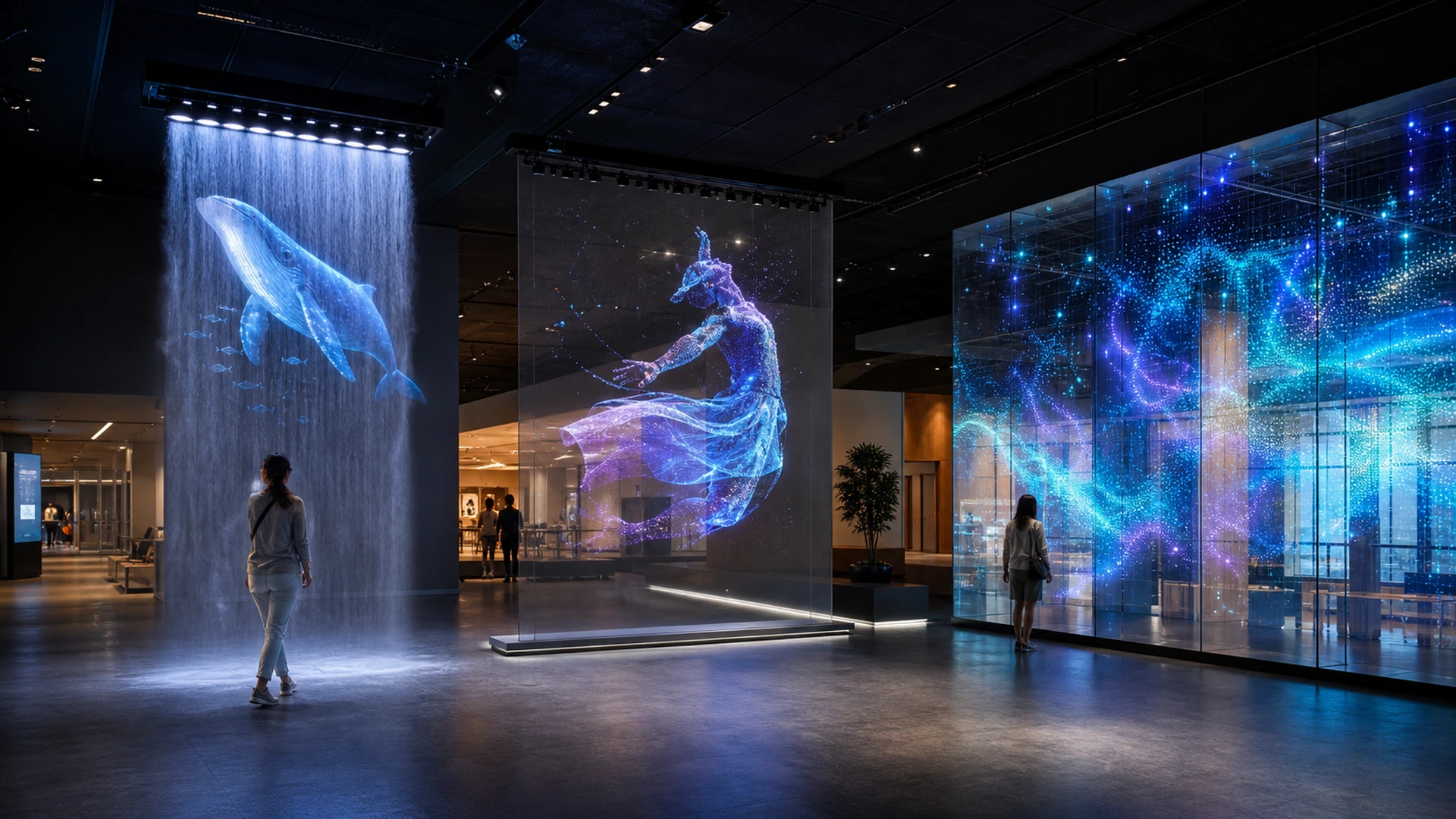
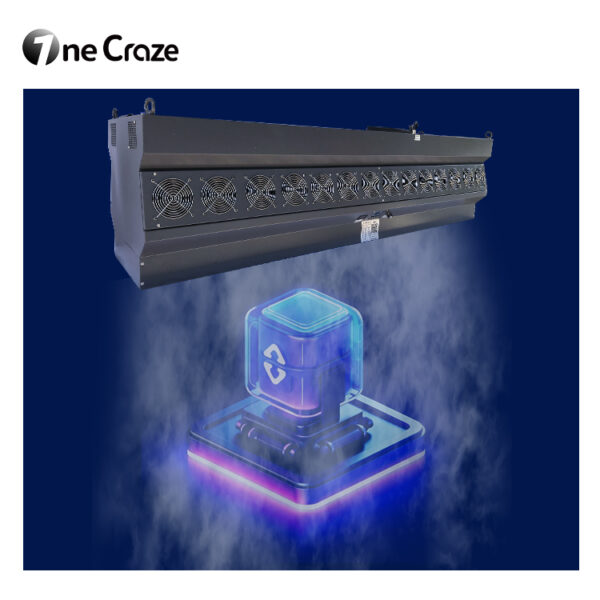
A fog screen creates a thin vertical curtain of water droplets. Fans guide the mist downward while a projector sends video onto it. Because the projection surface consists of suspended droplets, a visitor can physically pass through the image. This makes fog projection especially effective for portals, reveals and dramatic entrances.
A holographic scrim uses a fine, tensioned mesh as the projection surface. When the lighting and viewing angle are controlled, the audience notices the projected subject more than the mesh, which creates a floating-image illusion. Unlike a fog curtain, however, the scrim remains a physical material. Visitors cannot walk through the active screen unless the installation includes a separate opening or stage mechanism.
Transparent LED uses illuminated pixels mounted on a transparent panel, film or grid. It does not need a projector or a mist generator. It can preserve part of the view through a window or open architectural feature while displaying bright digital content. Nevertheless, the pixel structure remains visible at close range, and pixel pitch affects how near the audience can stand before the image looks coarse.
These are all commonly marketed as holographic displays, but none should automatically be treated as a true volumetric hologram. Buyers should specify the visible effect and operating conditions instead of relying on the word “hologram.” The OneCraze guide to hologram projector types and commercial uses provides a broader introduction to these display categories.
Fog Screen vs Transparent LED vs Projection Scrim: Quick Comparison
The following table gives buyers a practical starting point. Final performance still depends on equipment selection, room conditions and installation quality.
| Decision factor | Fog screen | Holographic projection scrim | Transparent LED |
|---|---|---|---|
| Projection surface | Atomized water curtain | Fine physical mesh | Self-emitting LED pixels |
| Can visitors pass through the image? | Yes, when the visitor route and machine are designed for walk-through use | No, not through the installed mesh itself | No, not through the display structure |
| Water or aerosol generation | Yes | No | No |
| Projector required | Yes | Yes | No |
| Best lighting condition | Controlled or darker indoor space | Controlled stage or exhibit lighting | Moderate to bright indoor space, subject to model specifications |
| Airflow sensitivity | High | Low to moderate; fabric movement must still be controlled | Low after correct structural installation |
| Black level | Black content mainly appears transparent | Depends on projection, background and stage lighting | Limited by pixel and transparency design |
| Close-view image detail | Softer, atmospheric image | Can be detailed with the right projector and viewing distance | Depends strongly on pixel pitch |
| Typical installation feature | Ceiling-mounted generator, water and drainage plan | Frame, tensioning, rigging and concealed background | Panel or film structure, controller, power and data |
| Daily maintenance focus | Water quality, atomizers, reservoir, fans and drainage | Screen cleanliness, tension and projector alignment | Modules, power supplies, controllers and surface cleaning |
| Strongest visual advantage | A genuine walk-through floating image | Large-format theatrical illusion without water | High-impact transparent digital signage |
Transparent LED is not one fixed specification. For example, an LG commercial transparent LED film lists 1,000-nit typical brightness and 60% typical transmittance for that particular model. Other products can use different pixel pitches, brightness levels, transparency ratios and supporting structures. Buyers should request the exact model data instead of applying one manufacturer’s figures to every transparent LED installation.
When Is a Walk-Through Fog Screen the Better Choice?
A fog screen is the strongest option when walking through the image forms part of the experience. For example, a museum can turn the entrance to a gallery into a moving historical portal. A themed attraction can let visitors pass through fire, clouds or a digital waterfall. A product launch can reveal guests through branded animation, while a hotel or event space can use the curtain as a short-duration visual centerpiece.
In addition, the mist adds an atmospheric texture that a flat display cannot reproduce. The image changes slightly as people pass through it, which can make the experience feel more physical and memorable. A depth camera, LiDAR or other sensor can also trigger the content as a visitor approaches.
However, the venue must control the environment. HVAC outlets, open doors and strong cross-drafts can distort the fog plane. Bright ambient light can reduce contrast, while poor drainage or excessive mist output can increase moisture deposition. The design must also provide safe overhead suspension, clean-water management, accessible maintenance, an emergency stop and suitable floor protection.
For these reasons, buyers should request a live factory acceptance test that records continuous operation, water consumption, noise, humidity change, floor condition and repeated walk-through moisture results. The OneCraze article on choosing a walk-through holographic fog curtain manufacturer includes a more detailed FAT checklist and system specification guide.
Fog projection is ideal when the walk-through moment justifies the additional environmental controls. If the venue only needs a transparent display and visitors do not need to cross the image plane, a no-water alternative may be easier to operate.
When Is Holographic Projection Scrim the Better No-Water Alternative?
A holographic scrim works well when a venue wants a large floating performer, character or object without producing water mist. Museums can place a projected narrator in front of a physical set. Exhibitions can reveal a virtual product above a platform, while theaters and events can combine projected figures with live performers.
The installation normally needs a rigid or tensioned frame, enough projection distance and careful control of light behind and around the mesh. Dark backgrounds help the screen disappear, while bright objects behind it can reveal the material. Content also matters: subjects surrounded by black usually create a more convincing illusion than a conventional full-frame video.
Scrim projection can scale to a wide stage and can support front or rear projection. It also avoids water filling, atomizer replacement and humidity concerns. On the other hand, it is not a true walk-through screen. The mesh occupies a defined plane, so the supplier must keep it outside visitor circulation and protect it from touching, vibration and accidental impact.
This option is often a good compromise for museums, auditoriums and controlled exhibitions. It creates a more theatrical result than standard digital signage, yet it removes the water system required by fog projection. OneCraze can integrate the scrim, projector, lens, playback system, rigging, content and show control as one solution.
When Does Transparent LED Work Better in a Bright Lobby?
Transparent LED becomes attractive when the display must remain visible in a brighter environment or operate for long commercial hours. It produces light directly, so it does not rely on a projector reflecting from mist or mesh. It can also integrate with glass walls, freestanding frames, stage structures or architectural openings, depending on the selected product.
Shopping malls can use transparent LED for storefront campaigns and atrium features. Corporate headquarters can display data or brand stories without fully blocking the background. Airports and visitor centers can combine directional information with visual content, while hotel lobbies can schedule different scenes throughout the day.
Nevertheless, transparent LED does not automatically deliver the most realistic “hologram.” A large pixel pitch may suit long-distance viewing but look rough at close range. Supporting cables, frames and power systems can also reduce the clean transparent effect. Moreover, transparent content needs its own design language: bright particles, outlines and isolated objects usually work better than dark cinematic scenes.
The supplier should confirm pixel pitch, minimum viewing distance, brightness, transparency, panel dimensions, weight, heat output, service access and content-controller compatibility. A site mock-up is especially useful when daylight changes significantly between morning and evening.
Which Display Should Hospitals, Museums, Malls and Hotels Choose?
Venue type gives buyers a useful starting point, but the final choice must follow the site assessment.
| Venue or project goal | Recommended starting option | Why |
|---|---|---|
| Hospital or medical-center lobby | Transparent LED or enclosed scrim installation | No atomized-water curtain in the public route; easier separation from visitors |
| Museum story portal that visitors cross | Fog screen, subject to environmental and facility approval | The visitor can physically pass through the projected scene |
| Museum narrator or virtual artifact | Holographic scrim | Large theatrical illusion without a water system |
| Bright shopping-mall atrium | Transparent LED | Direct-view brightness and scheduled commercial operation |
| Dark themed-attraction entrance | Fog screen or scrim | Both can produce a dramatic reveal in controlled light |
| Retail window or glass façade | Transparent LED film or panel | Preserves part of the view through the glass |
| Temporary product launch | Fog screen or portable scrim | Strong short-duration impact with event-style control |
| Hotel lobby feature | Transparent LED, scrim or fog after site review | The right choice depends on light, airflow, maintenance and desired guest interaction |
Healthcare projects require additional caution. The CDC guidance for decorative fountains states that decorative fountains produce aerosols and advises against placing them in healthcare facilities used by people at increased risk of Legionnaires’ disease. A fog screen is not identical to every decorative fountain, but both can aerosolize water. Therefore, OneCraze does not recommend treating a “dry fog” marketing claim as medical approval.
The hospital’s infection-control, facilities and water-management teams should review the proposed technology before purchase. They may require independent particle, microbiological, moisture and ventilation testing, or they may select a no-water display instead. Buyers can read the separate OneCraze assessment of walk-through fog screens in hospital lobbies before preparing a request for quotation.
For any venue, a capable solution provider should request the following project information:
- Floor plan, ceiling height and structural load information
- Audience distance, walking route and accessibility requirements
- Ambient-light readings at different times of day
- HVAC outlet locations and measured cross-air velocity
- Available projection distance and equipment-room space
- Daily operating hours and expected visitor volume
- Water, drainage and floor-protection conditions if fog is considered
- Required content, interaction, show control and remote diagnostics
- Local electrical, fire, rigging and facility approval requirements
These details allow OneCraze to compare complete solutions rather than comparing only the headline price of one screen component. For museum and visitor-center projects, see more examples in interactive projection for museums and exhibitions.
No. A fog screen uses projected light on suspended water droplets, while transparent LED creates the image with self-emitting pixels. A fog screen can form a walk-through image, whereas a transparent LED display remains a physical installation.
Yes, when the project needs a floating-image illusion but does not require visitors to pass through the image plane. The scrim eliminates the water system, although it still requires a frame, controlled lighting and suitable projection geometry.
Transparent LED is usually the first option to evaluate because it emits light directly. However, buyers must still compare brightness, pixel pitch, transparency and the viewing distance against measured site conditions. A shaded or enclosed installation can also make projection-based options possible.
Ask OneCraze to Compare the Three Solutions for Your Venue
OneCraze can supply a fog screen as hardware only, configure a complete projection package or develop a turnkey interactive installation. When water mist does not fit the site, the team can also evaluate a holographic scrim, transparent display or another projection format.
View the OneCraze 3D hologram fog screen display system or contact OneCraze with your venue drawings, audience distance, ambient-light level, airflow conditions and intended visual effect. OneCraze will recommend the display technology, equipment configuration and testing plan that best fit the project.