What Is an Interactive Target Throwing Arena?
Digital dodgeball meets illuminated target gameplay
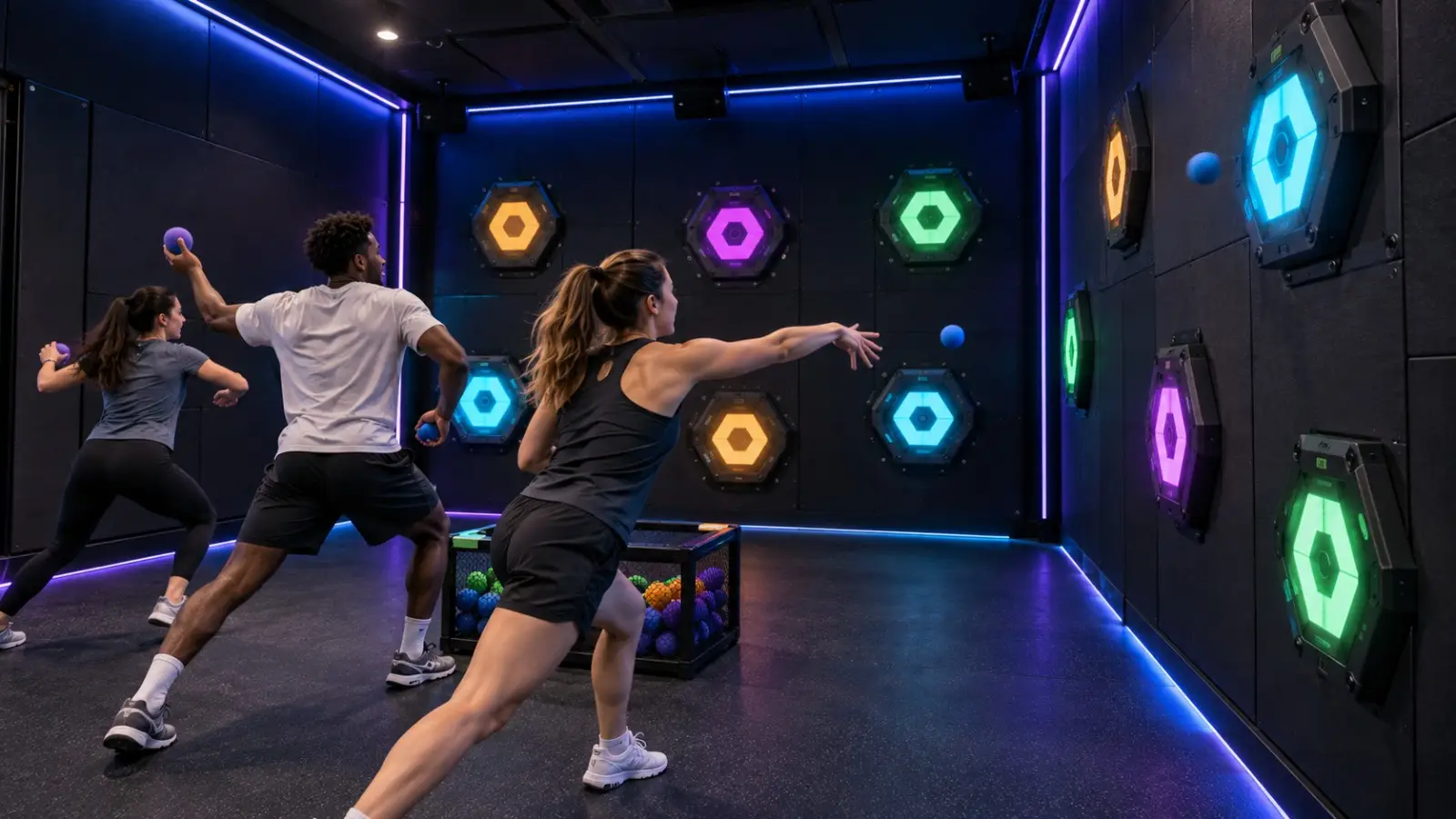
An interactive target throwing arena is an enclosed active game room with multiple illuminated targets installed across one or more walls.
The software activates different target colors and patterns. Players must then identify and hit the correct targets before the timer expires. Meanwhile, the system detects each successful hit, updates the score and triggers visual or audio feedback.
The OneCraze Activate LED Game Room Arena combines digital dodgeball-style gameplay with responsive hexagonal LED targets. It supports multiplayer challenges and provides six basic game modes. Operators can also create additional games through the management system.
How Does the LED Target Arena Work?
Sensors connect every ball hit to the scoring software
First, players select a game mode and enter the arena. Next, the control system starts the countdown and activates specific wall targets.
Players throw balls at the illuminated targets. Sensors register the correct hits and send the information to the game software. The system then changes the lights, updates the score and activates the next target sequence.
A typical playing cycle includes:
- The system displays the rules.
- The countdown begins.
- LED targets change color.
- Players hit the assigned targets.
- Sensors register successful and incorrect hits.
- The software calculates the final score.
- The display shows team results or rankings.
Because the system controls the targets automatically, staff do not need to reset physical objects after every round. As a result, the arena can support short sessions and frequent player rotation.
What Equipment Does the Arena Need?
A complete system includes more than illuminated targets
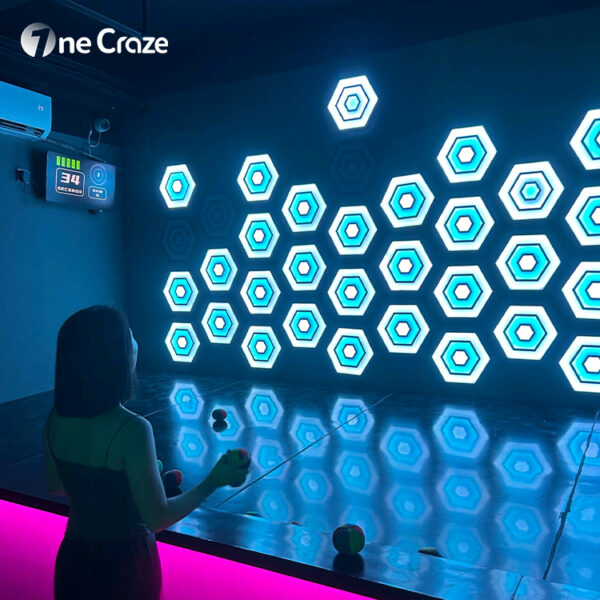
A typical package can include:
- Hexagonal RGB LED target modules
- Hit-detection or infrared sensors
- Game control computer
- Central control cabinet
- Game management software
- Touchscreen operator interface
- Score and countdown display
- Speakers and sound effects
- Commercial throwing balls
- Network and power equipment
- Wall mounting structures
- Optional RFID player identification
- Optional central leaderboard
OneCraze’s Arena target modules measure approximately 30 × 26 × 6 cm. However, the final quantity and target arrangement should match the room dimensions, expected player capacity and selected gameplay.
Buyers who want to compare other wall-based technologies can also review the sports target wall game system. For a wider attraction mix, operators can explore the complete range of OneCraze Activate LED game solutions.
Which Game Modes Can Operators Offer?
Different rules increase replay value without rebuilding the room
One of the most common buyer questions is: Can one target throwing arena provide more than a basic hit-the-light game?
Yes. The software can change target colors, timing, sequences, penalties and scoring rules. Therefore, operators can serve different age groups and group types with the same hardware.
Suitable game modes include:
- Speed Challenge: Players hit as many targets as possible before time expires.
- Color Match: Teams may hit only the assigned color.
- Avoid the Red Target: Players gain points for correct hits and lose points for striking red targets.
- Team Battle: Two teams compete for the highest score.
- Cooperative Mission: All players work together to clear the wall.
- Memory Sequence: Players remember and repeat a changing target pattern.
- Accuracy Mode: Smaller or less convenient targets provide higher scores.
- Progressive Levels: The software reduces response time as players advance.
Moreover, operators can customize target sequences, difficulty, game duration, language, branding and sound effects. This flexibility helps the arena support children, teenagers, adult groups and corporate events.
The venue can also combine Arena with an interactive Hoops challenge, Mega Laser Maze or Lava LED floor room.
How Should You Plan the Room Layout?
Safe throwing distance and player movement determine the design
OneCraze recommends a minimum reference space of approximately 3 × 5 meters for its standard Arena configuration. Nevertheless, the final layout should depend on player capacity, target quantity, door position and local safety requirements.
A practical layout should include:
- An instruction and starting area
- A clear player movement zone
- Suitable distance between players and targets
- Protected wall-mounted equipment
- Safe cable routing
- An accessible control cabinet
- A staff observation position
- A clear entrance and emergency exit
- Ball collection and storage space
Additionally, the room should use a flat, non-slip floor. Operators should choose soft balls that match the target system and avoid placing hard objects inside the throwing area.
The manufacturer should prepare target placement drawings before installation. It should also test sensor accuracy, lighting visibility, sound levels and scoring responses before opening the room.
For venues planning multiple connected games, OneCraze’s guide to an interactive LED floor and wall game room provides additional configuration ideas.
What Should a Manufacturer and Solution Provider Supply?
Reliable integration matters more than purchasing separate components
A hardware supplier may sell LED targets. However, a complete commercial arena requires compatible hardware, responsive software and professional room planning.
An interactive target throwing arena manufacturer and solution provider should offer:
- Target module production
- Sensor and control system integration
- Customized game software
- Room layout and target positioning
- Electrical and network drawings
- Scoring and leaderboard configuration
- Branding and language customization
- Installation and calibration guidance
- Staff operation training
- Spare parts and technical support
- Future game content updates
OneCraze provides integrated interactive entertainment solutions instead of isolated components. Its support can cover system planning, equipment manufacturing, software configuration, custom gameplay, room layout and installation assistance.
Therefore, buyers can develop one Arena room or combine several attractions into a complete active gaming center. OneCraze can also provide OEM and ODM support for operators who need customized colors, logos, game rules or venue themes.
Explore the company’s interactive entertainment equipment, review its custom project experience, or contact OneCraze to discuss a room size and target configuration.
An LED target arena uses physical illuminated target modules that detect hits. A projection wall displays digital images on a surface and generally uses cameras or infrared sensors to detect ball contact. Both can support throwing games, but they use different display and interaction technologies.
OneCraze lists approximately 3 × 5 meters as the minimum reference space for its Arena system. However, the manufacturer should confirm the final size according to the number of players, target layout, throwing distance and safety clearance.
Yes. OneCraze can customize game modes, scoring rules, difficulty levels, target sequences, branding and language. The Arena includes six basic modes, while administrators can create additional gameplay through the backend system.