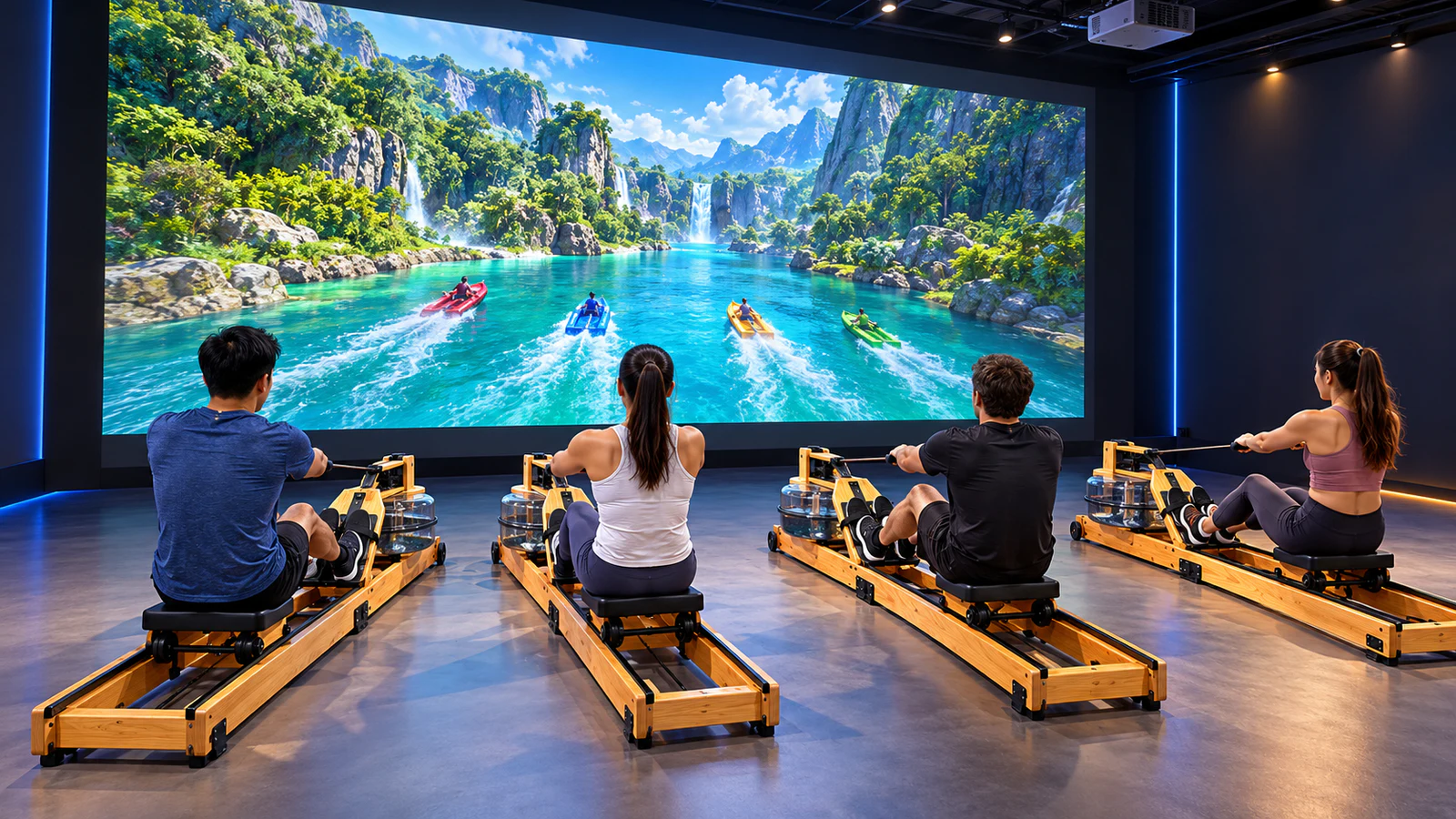
The published OneCraze interactive rowing simulator package lists four rowing units, a projector, an integrated host with touchscreen and game software. Its competition and chase modes support one to four participants. This provides a starting point for planning a four-player racing attraction, with the final equipment and software configuration confirmed in the quotation.
What Does a Four-Player Rowing Race Actually Involve?
Four-player participation does not automatically mean that four people control one boat. Buyers should distinguish individual competitors in a shared race from cooperative crew play, team scoring and relay formats.
OneCraze’s published competition mode describes a race to the finish followed by rankings. Therefore, a sensible demonstration should show how each physical station maps to its on-screen participant, how the race starts and how the result identifies each player.
For visitors arriving together, the appeal is a shared challenge with a clear outcome. However, the operator still needs to explain the controls and direct each person to the correct station. Ask someone unfamiliar with the system to try this process during the demonstration.
If you want birthday teams or corporate groups to compete, specify the intended format. Staff could organize separate heats, but automatic team totals, tournament brackets and persistent leaderboards require their own software confirmation.
Within a broader sport-themed entertainment center equipment mix, rowing introduces a seated physical interaction alongside standing, throwing or stepping games. Plan it as a distinct experience rather than assuming every sports attraction serves the same visitors.
Which Game Mode Should You Use?
The product page lists competition, chase and practice modes. Instead of presenting them simply as three menu choices, consider how each changes the visitor session.
| Mode | Published gameplay | Operating consideration |
|---|---|---|
| Competition | One to four players race, with rankings at the finish | Explain station identification and the finish condition before starting |
| Chase | One to four players try to escape pursuing creatures; specified stroke challenges can allow escape after capture | Show what happens when one player is eliminated before others finish |
| Practice | Open-ended play with displayed activity data | Agree how staff end the session and release the station for waiting guests |
Competition offers a straightforward format to demonstrate first. Meanwhile, chase mode adds a different objective, so staff should explain its rules rather than assuming that every visitor understands them from the graphics.
For scheduling ideas, the multi-sport game rotation guide discusses organizing activities for different visitor groups. Apply the planning approach, not another product’s capacity assumptions.

How Should You Arrange Four Rowing Stations?
Start with a dimensioned drawing of the selected equipment, including its full movement envelope. The current product information does not establish a verified minimum room size, so do not reserve space based only on a photograph.
Ask the supplier to show:
- Player positions and sightlines: Every seated participant should be able to identify their game information from the proposed position.
- Entry and exit routes: Players need a defined way to reach and leave their stations without crossing another person’s moving equipment.
- Operator access: Staff need access to controls and the areas identified in the operating manual.
- Waiting and viewing space: Spectators should remain separate from the active equipment and circulation route.
The active game center layout guide can help place the attraction within a larger venue. For the visual installation itself, use the projector buying guide to frame questions about the lens, mounting and ambient light. Neither replaces a configuration-specific installation drawing.
Can the Attraction Run Without Four Players?
The published competition and chase modes allow one to four participants. Nevertheless, confirm how staff select the active stations and start a session with fewer visitors. Do not assume the software fills empty positions with virtual opponents.
During the demonstration, request a one-player session, a two-player session and a full four-player race. Also check whether late arrivals must wait for the next start and what the system does when someone stops participating.
Next, time the complete changeover: explanation, station setup, gameplay, results, exit and preparation for the next group. This is more useful for queue planning than timing only the animated race.
Avoid calculating attendance by multiplying four seats by a theoretical number of rounds. Actual occupancy, instruction time and visitor turnover affect the result. Use measured trial sessions and your expected demand when setting an operating plan.
Before opening, obtain the supplier’s user restrictions, supervision guidance and cleaning procedure. Staff should know how to assist visitors and stop a session using the documented controls.
What Should You See Before Approving the Order?
A promotional clip can show the theme, but a purchasing demonstration should show the physical equipment and screen together. Ask for an uninterrupted session that makes the relationship between rowing input and game response visible.
Focus on five checks:
- Each station controls the intended on-screen participant.
- The selected players enter the same race correctly.
- Stopping or resuming movement produces the expected response.
- Finishing, elimination and participant withdrawal follow the agreed rules.
- Staff can return to the menu and prepare the next session reliably.
Also request a walkthrough of routine inspection, cleaning and service access. Clarify which replacement components the supplier recommends and how support identifies a station-specific problem.
Use the factory acceptance test checklist to record the approved software version and hardware configuration. Separately, the supplier quotation comparison guide helps distinguish equipment pricing from delivery, installation and commissioning charges.
Not necessarily. Confirm whether players race individually, control a shared boat or contribute to a combined score. The published competition description establishes racing and rankings, not every possible team format.
Ask for a separate configuration proposal. Support for fewer active players does not automatically mean the four-unit hardware package can be reduced without changes to pricing, wiring or software.
The product page lists Simplified Chinese and English, with language customization offered. Confirm the required language across instructions, menus and results, plus any additional development charge and approval process.