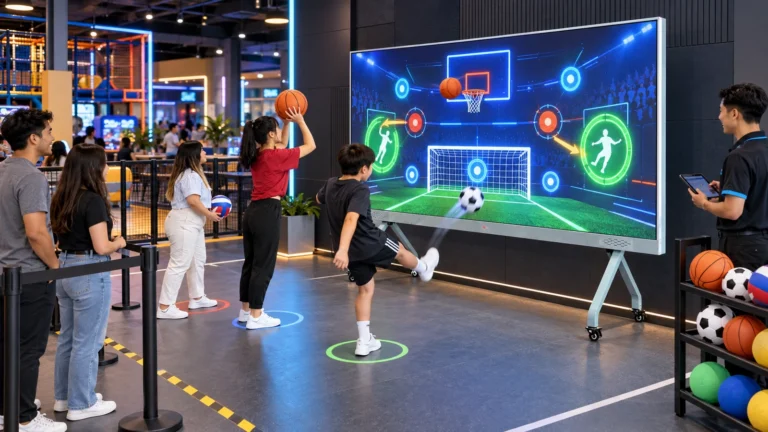
first review the OneCraze guide to interactive multi-sport wall projector ball tracking. It explains why soccer, basketball and tennis-style balls do not create identical sensing conditions.
What Properties Should an Interactive Ball Wall Have?
A clean white surface can display a bright image, but color alone does not make it suitable for ball play. The project team should inspect flatness, finish, substrate, joints, edges and the area around the projection.
An effective interactive ball wall normally provides:
- Low-gloss finish: Reduces glare and visible hotspots.
- Light neutral color: Reflects useful projected light without strongly tinting the game.
- Consistent flatness: Keeps targets and sensor coordinates aligned.
- Impact durability: Resists dents, cracks, peeling and loose panels.
- Cleanable surface: Handles shoe marks, dust and ball contact.
- Controlled seams: Avoids raised joints that distort the image or change rebound.
- Protected surroundings: Keeps glass, sockets and sharp corners outside the active zone.
Moreover, the visible projection rectangle is not the complete impact area. Balls miss targets, bounce sideways and land above or beside the image. Consequently, protective treatment may need to extend beyond the projected width and height.
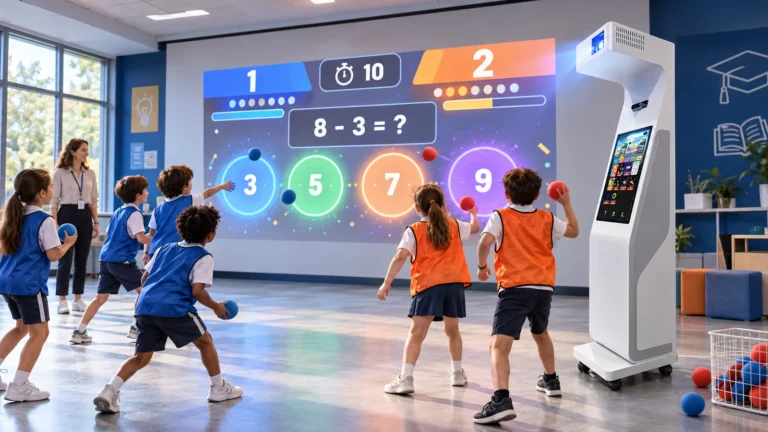
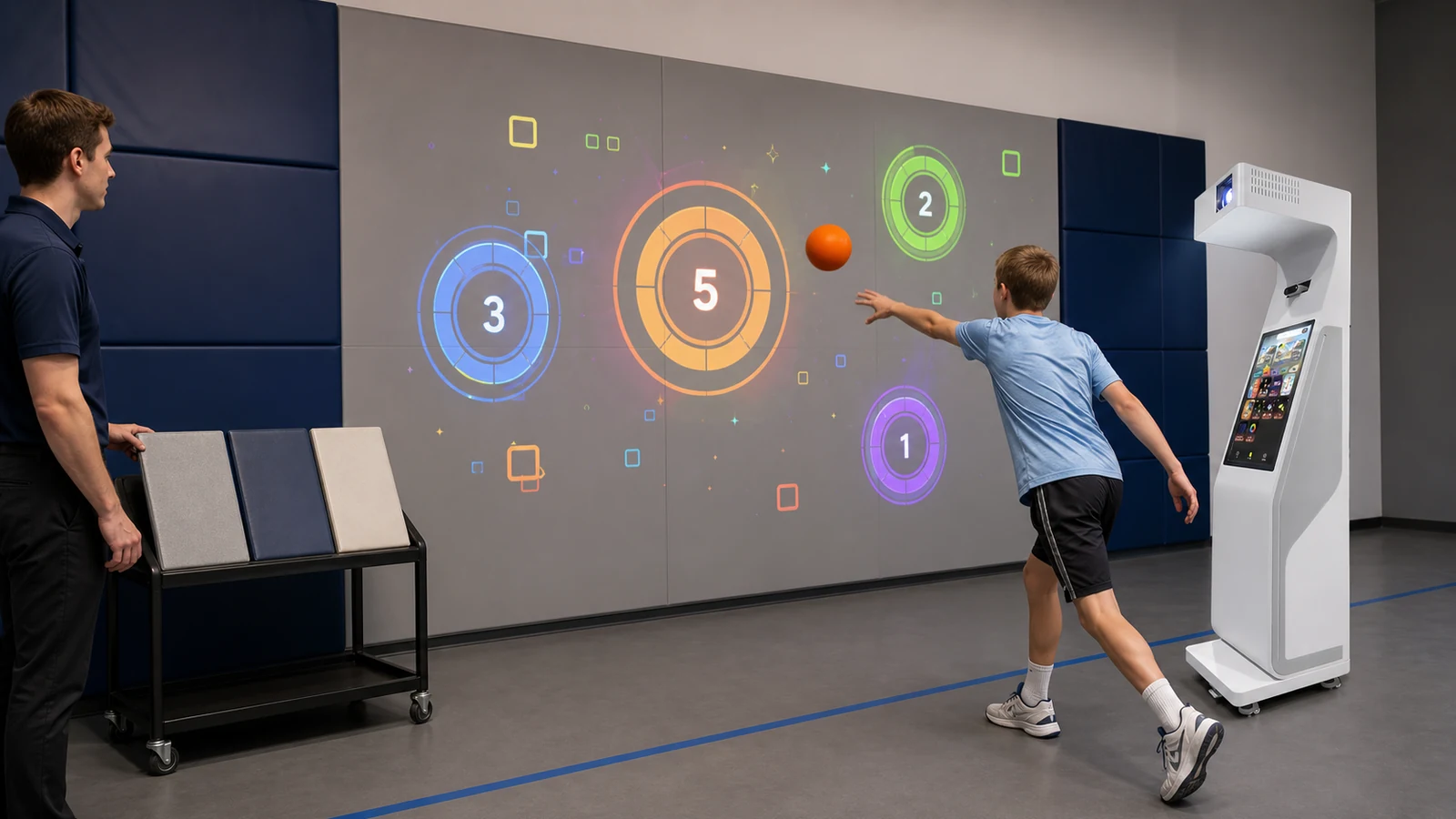
The OneCraze Smash Ball interactive wall projection system shows the basic commercial format: players throw balls at projected objects while the system detects hits and updates the game. Buyers should still confirm the approved ball and wall construction for their project.
Which Wall Materials Work Best for Ball-Throwing Projection?
Several materials can support an interactive wall projector, provided the installer prepares them correctly. The following comparison is a planning guide rather than a structural approval.
| Wall or facing material | Projection quality | Impact performance | Main concern | Typical use |
|---|---|---|---|---|
| Smooth matte painted masonry | Very good | Durable substrate | Hard rebound, noise and surface marking | Permanent commercial rooms using approved soft balls |
| Standard painted drywall or plasterboard | Very good when flat | Limited without protection | Dents, cracks and damaged corners | Light supervised use or pilot testing |
| Painted plywood over a designed frame | Good | Better resistance than basic drywall | Joints, warping and fire-rating requirements | Custom indoor sports wall built by a qualified contractor |
| Matte impact-resistant wall panel | Good to very good | Designed for repeated contact when correctly specified | Gloss, visible fasteners and panel seams | Schools, gyms and high-throughput FECs |
| Padded vinyl or foam-faced panel | Fair to good | Reduces hard impact | Texture, seams, cleaning and sensor response | Children’s areas using lightweight balls |
| Standard tensioned projection screen | Excellent for viewing | Usually not intended for repeated ball impact | Stretching, tearing and movement | Display-only projection unless explicitly impact rated |
| Bare glossy tile, glass or metal | Poor to fair | Material dependent | Glare, dangerous breakage or unpredictable rebound | Generally unsuitable inside the active ball zone |
For movable installations, the OneCraze portable interactive wall projector all-in-one reduces permanent projector mounting work. However, portability does not remove the need for a suitable impact wall and clear play area.
What Color and Paint Finish Improve Projection?
White and light gray remain the most practical colors. White usually maximizes brightness, while a very light neutral gray can reduce the appearance of glare and improve perceived black levels in some controlled rooms. In contrast, saturated wall colors alter the projected colors and make calibration less predictable.
Before painting the full wall, test a sample panel with:
- The exact projector and lens
- Normal venue lighting
- Bright, medium and dark game scenes
- The intended viewing and throwing positions
- The approved cleaning product
- Repeated impacts from the specified soft ball
Industry product information supports the same general direction. Bamigos specifies a light-colored matte wall and soft foam balls for its ball-throwing wall system. Similarly, the Magicdynamics interactive sports wall configuration recommends a light matte projection surface and links ball size to sensor selection.
Buyers planning a commercial attraction can find broader projector, lighting and player-flow considerations in the OneCraze guide to interactive wall projection games for FECs.
Should an Interactive Sports Wall Use Padding?
Padding can reduce noise and soften contact, but it is not automatically required. The decision depends on player age, ball energy, throwing distance, wall substrate and venue risk assessment.
If the project uses padding, the buyer should verify:
- Foam density and thickness
- Facing material and matte reflectivity
- Panel joint design
- Attachment method and replacement access
- Cleaning and disinfectant compatibility
- Fire, smoke and indoor-material documentation required locally
- Ball response at the center, seams and panel edges
- Sensor performance after the final facing is installed
The correct surface also depends on sensing technology. A camera may see printed patterns or shadows, while LiDAR performance depends on scan position and object geometry. The OneCraze comparison of LiDAR, infrared cameras and depth sensors can help buyers prepare the sensor discussion with their supplier.
How Should Ball Type and Operating Intensity Change the Wall Design?
A wall that survives occasional foam-ball play may fail under continuous commercial operation. Therefore, the quotation should define both the ball and the expected daily use.
| Operating scenario | Ball starting point | Wall starting point | What to verify |
|---|---|---|---|
| Supervised kindergarten activity | Large lightweight foam ball | Smooth matte surface with protected corners; padding if required by the venue | Cleanability, loose edges and low-speed detection |
| School PE or activity room | Soft foam or lightweight training ball | Durable matte facing over a suitable substrate | Repeated class use, noise and easy repair |
| FEC target-throwing attraction | Supplier-approved washable soft ball | Replaceable commercial impact panel or tested wall assembly | High hit count, missed throws and maintenance intervals |
| Gym reaction training | Defined soft training ball | Flat durable wall built for the approved drill | Faster throws, rebound and clear safety distance |
| Regulation or high-speed sports ball | Project-specific only | Specialist engineered impact system | Structural review, high-speed tracking and formal site approval |
The OneCraze sports target wall game system provides another reference for reaction and multiplayer applications. Schools considering several activities in one system can also review the portable multi-sport ball interactive device.
For all-in-one hardware selection, see the guide to a portable interactive wall projector machine. It explains how integrated equipment can simplify deployment while still requiring room and surface planning.
How Should the Wall Be Tested Before Installation Approval?
A supplier video recorded on an unknown white wall does not validate the customer’s site. Instead, the buyer should provide wall details, surface samples and operating requirements before production finishes.
The site information should include:
- Wall width, height and construction
- Photos showing joints, corners, sockets and nearby glass
- Final paint or panel product information
- Ambient lighting at the wall
- Approved ball specifications
- Player age and maximum participant count
- Throwing or kicking distance
- Expected operating hours and daily sessions
Next, the supplier should perform a factory acceptance test using the final projector, sensor, software and ball. The test should cover the center, corners, seams and areas close to the image boundary. It should also include repeated impacts rather than a single successful throw.
Schools and gyms can use the OneCraze guide to interactive gym wall games for additional layout considerations. For a high-volume order, approve one pilot room before repeating the same wall specification across several venues.
It may work for light use with approved soft balls if the wall is flat, matte and in good condition. However, standard drywall or paint may mark or dent during repeated commercial operation, so test the actual assembly first.
A standard screen is designed for viewing, not repeated impact. Use it only if the screen manufacturer explicitly approves the intended ball contact and installation method.
White usually provides the brightest image. A very light neutral gray may control perceived glare in some rooms. Test both colors with the exact projector, lighting and game content before painting the complete wall.
Contact OneCraze with your wall construction, surface photos, approved ball, room dimensions, player age, required games and order quantity. The team can recommend a projector and sensor configuration and prepare a wall-surface factory test plan.