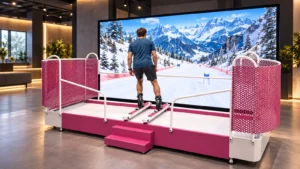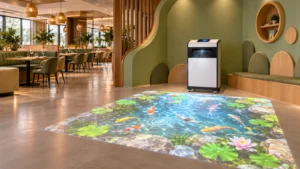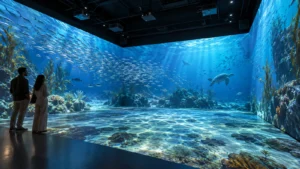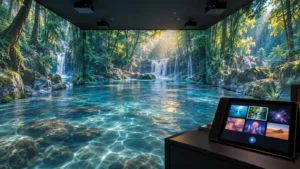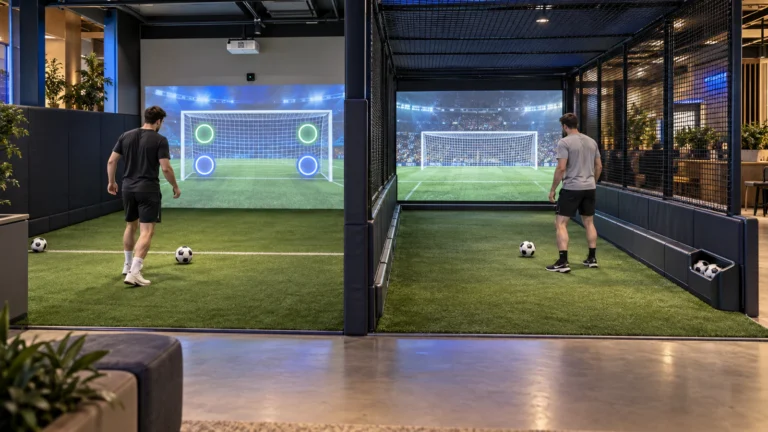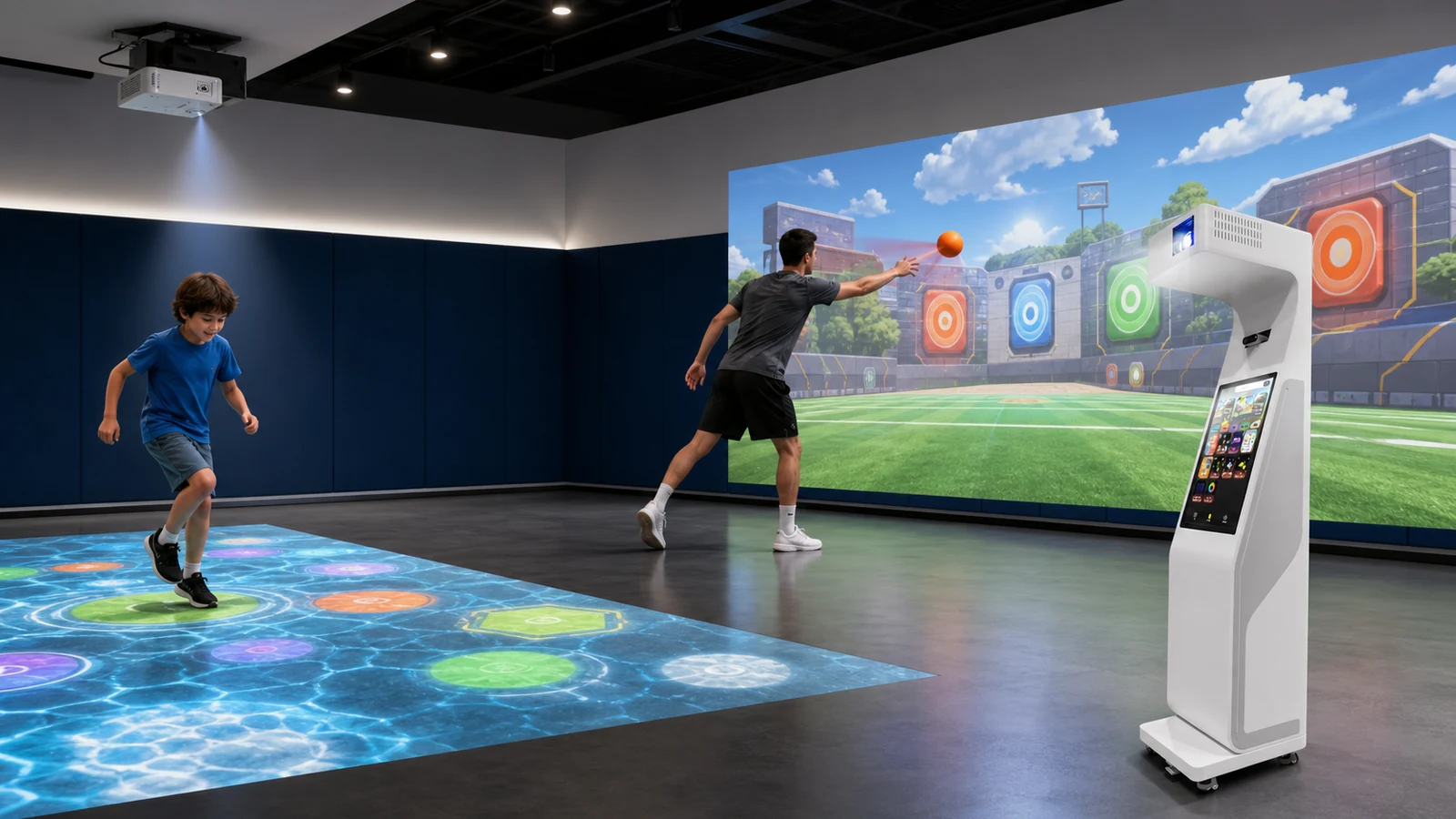
A children’s play area may need simple floor games and a protected installation, while a gym may require ball tracking, score records and durable wall materials. Buyers can begin by reviewing the OneCraze interactive projector product range before comparing individual configurations.
What Types of Interactive Projection Games Are Available for Sale?
| System type | Main interaction | Typical venue | Installation format | Best suited to |
|---|---|---|---|---|
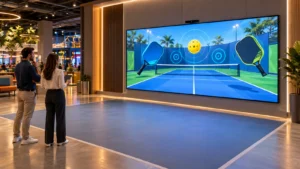
| Interactive wall projection | Ball throwing, touch, gesture or body movement | Gym, FEC, school, trampoline park | Fixed or portable | Sports, target and reaction games |
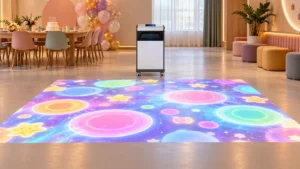
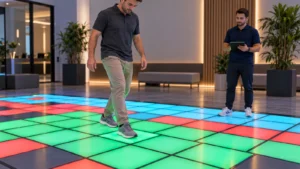
| Interactive floor projection | Foot movement and full-body tracking | Kids’ area, mall, museum, school | Ceiling-mounted or mobile | Group play and educational activities |
| Portable all-in-one projector | Motion sensor with integrated control | Events, rental, multi-room venues | Wheeled machine | Fast setup and relocation |
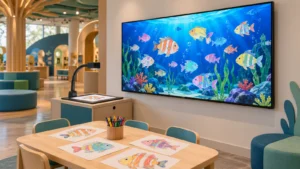
| Interactive drawing projection | Scanner, camera and touch interaction | Museum, art center, education venue | Fixed activity zone | Creative and educational experiences |
| Interactive table projection | Object, touch or cue tracking | Restaurant, billiards club, exhibition | Overhead or integrated | Table games and branded experiences |
| Immersive projection room | Multi-wall or floor movement tracking | Exhibition, tourism, entertainment center | Permanent multi-projector installation | Large-format group experiences |
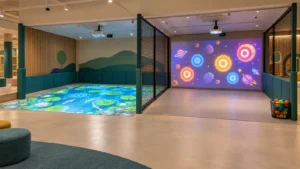
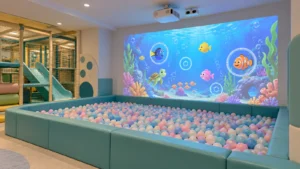
An interactive wall projection system can support target games, sports drills and multiplayer activities. In contrast, an interactive floor projection mapping system converts a clear floor area into a motion-responsive play zone.
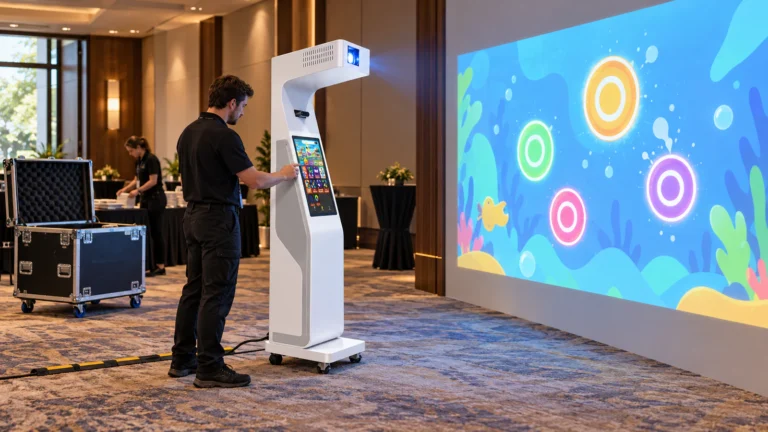
Venues that cannot install ceiling equipment may prefer a portable wall projector all-in-one machine. The integrated design can combine the projector, sensor, computer and touchscreen, although the buyer must still provide a suitable wall and safe player area.
What Is Included When You Buy an Interactive Projection Game System?
The phrase “interactive projection game system” may describe software alone, a hardware package or a complete turnkey attraction. Consequently, buyers should request an itemized bill of materials instead of relying on one total price.
| Quotation item | Hardware-only package | Turnkey package | What to verify |
|---|---|---|---|
| Projector and lens | Usually included | Included and selected for the site | Brand, model, ANSI lumens, resolution and throw ratio |
| Motion sensor | Included when required | Included, mounted and calibrated | Sensor type, active range and replacement availability |
| Computer and controller | Usually included | Included and configured | Processor, graphics, storage and operating system |
| Game software | Standard library or selected games | Agreed library plus configuration | Game count, license period and offline operation |
| Mounting accessories | Basic brackets and cables | Project-specific hardware | Safety cables, service access and local compliance |
| Audio and display controls | Optional | Included if specified | Speaker power, touchscreen and operator interface |
| Installation | Not included or remotely guided | Remote or on-site commissioning | Travel, local labor and acceptance responsibility |
| Custom content | Normally optional | Included only when listed | Branding, languages, new games and revision limits |
| Warranty and spare parts | Component warranty | System support package | Start date, response time and replacement process |
Buyers interested in creative activities can examine an interactive drawing projection system. Billiards clubs and entertainment venues may instead consider an interactive pool table projection system. Each product requires a different camera position, calibration and content package.
How Much Do Interactive Projection Games Cost?
The main price factors include:
- Projector brightness, resolution, lens and brand
- Infrared, depth-camera, radar or LiDAR sensing
- Computer and graphics performance
- Number and type of licensed games
- Portable cabinet or fixed mounting system
- Wall, floor or table dimensions
- Customized branding, languages and game development
- API, relay, RS232, RS485 or DMX integration
- Shipping method, destination and import requirements
- Remote installation or on-site commissioning
- Warranty period and spare-parts package
The exact lens can cost more than expected when the installation has limited throw distance. Official tools such as the Epson projection distance calculators and BenQ projector calculator can help a project team cross-check image size and mounting distance with the proposed model.
How Do Sensors Change the Game Experience?
Before selecting a system, confirm:
- Whether players use hands, feet, soft balls or full-body movement
- The number of simultaneous players
- The active detection width and depth
- Sensor mounting height and blind areas
- Ambient-light restrictions
- Required ball size, color and speed
- Calibration after the system is moved
- Replacement sensor and driver availability
A motion sensor interactive projector illustrates how the sensor, visual content and computer operate together. Nevertheless, software designed for one tracking method may not work correctly with another sensor without adaptation.
Which System Fits a School, FEC, Gym or Shopping Mall?
Gyms and sports centers should define whether the system supports entertainment, reaction training or measurable practice. If players throw balls, the wall must provide a clear matte image and withstand the approved impact. Shopping malls, meanwhile, may prefer a mobile system that can move between campaigns or activity zones.
Use the following questions during planning:
- What is the clear wall or floor size?
- How high is the ceiling?
- Can the venue control ambient light?
- Where will players and spectators wait?
- Does the attraction operate continuously or only during events?
- Does the buyer need portable or permanent equipment?
- Will the games require English, Arabic or other languages?
- Should scores connect to membership or leaderboard software?
- Who will perform local installation and maintenance?
The OneCraze guide to interactive floor and wall projector game functionality explains how software features and hardware choices affect the final experience. Buyers should send room photos and measurements before ordering because the same game can require a different projector or sensor in another venue.
Floor games and simple wall games are common choices because they support movement and group play. The correct system depends on player age, room size, lighting, supervision and required equipment protection.
Some hardware can be reconfigured, but wall and floor installations normally require different mounting, calibration and game layouts. Confirm the supported modes with the manufacturer before ordering.
Many systems can run locally, but licensing, cloud leaderboards, remote updates or membership integration may require a network connection. The quotation should explain offline behavior clearly.