how to estimate sand requirements and which measurements an AR sandbox equipment supplier needs to prepare an accurate quotation.
What Comes with a Complete AR Sandbox for Sale?
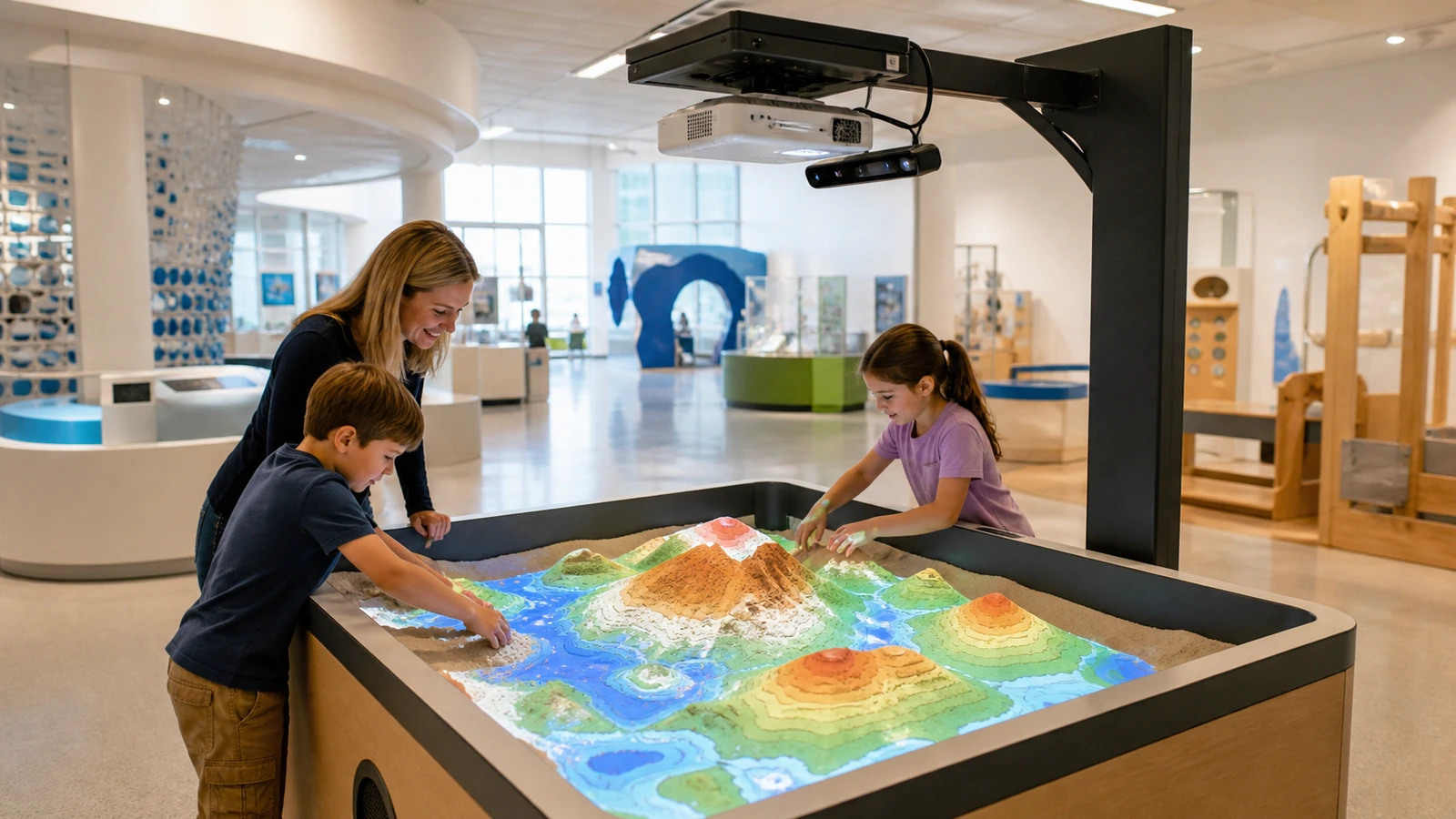
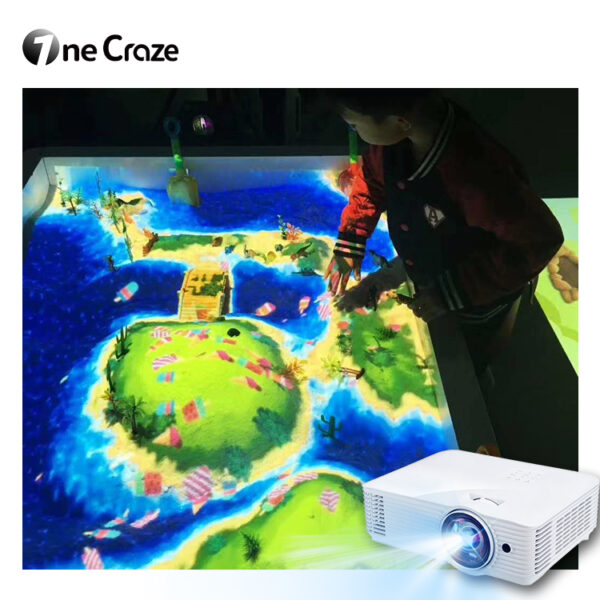
A commercial augmented reality sandbox combines a physical sand table with optical, sensing and computing components. The depth camera reads changes in the sand surface, the software converts the height data into terrain or game effects, and the projector places the updated image back onto the sand.
At minimum, ask the supplier to identify these items separately:
- Sandbox cabinet, internal liner and protective edge
- Upper frame, ceiling mount or independent equipment tower
- Projector and exact lens or throw ratio
- Depth camera and mounting bracket
- Computer, graphics hardware and operating system
- AR sandbox software, games and license term
- Monitor, tablet or operator control interface
- Speakers, power distribution and signal cables
- Calibration files, installation drawings and user manual
- Packing, remote support, warranty and spare parts
Some quotations exclude the sand, projector, display computer or installation frame. Others include only terrain visualization and charge separately for ocean, volcano, excavation or educational games. Consequently, buyers should compare an itemized scope instead of comparing only the total price.
OneCraze offers different content directions through its AR Sandbox Game for Kids and AR Gardening and Beach Interactive Game. If the attraction belongs to a larger gallery, the system can also be planned alongside other interactive museum and exhibition solutions.
What AR Sandbox Box Size Should You Choose?
The best box is large enough for the intended group but small enough for the sensor to retain useful surface detail. The original UC Davis installation guidance uses a 40 × 30 inch, or approximately 1 × 0.75 meter, sandbox as a reference arrangement. It also explains that enlarging the sandbox increases the required camera height and reduces depth resolution. Buyers should treat this as an optical design relationship, not as a universal commercial size. See the UC Davis AR Sandbox construction and calibration instructions for the underlying setup principles.
Use the following table as a planning conversation rather than a fixed specification:
| Venue requirement | Box-planning direction | What the buyer should verify |
|---|---|---|
| Small classroom or compact exhibit | Compact single-side or two-side access | Doorway, mobility, supervision and one-group capacity |
| Children’s museum or science center | Medium multi-user box with open viewing sides | Peak users, accessibility, sand containment and staff circulation |
| Indoor playground or FEC | Durable cabinet with protected corners and service access | Daily cleaning, impact resistance, queue position and operating hours |
| Custom educational model | Project-specific aspect ratio and content | Whether the camera and projector cover the full active surface |
| Large landscape table | Engineered frame and site-specific optical layout | Ceiling height, resolution, floor load and multi-projector requirements |
How Much Sand Does an AR Sandbox Need?
The required sand depends on the internal length, internal width and usable depth. Therefore, the supplier cannot calculate sand quantity reliably from an exterior product photo.
Use this first estimate:
Sand volume = internal length × internal width × average filled depth
Then estimate the operating mass:
Estimated sand mass = sand volume × measured bulk density of the selected sand
Bulk density changes with particle size, compaction and moisture. For that reason, do not use a generic internet value as the final structural load. Ask the local sand supplier for product data or weigh a measured sample, then add the cabinet, projector frame, computer and users’ applied loads to the engineering review.
Before ordering sand, confirm:
- Recommended particle size and color
- Washed, screened and low-dust specification
- Whether the software expects light-colored sand
- Minimum and maximum operating depth
- Local safety and hygiene requirements
- Cleaning, replacement and covered-storage procedure
- Whether kinetic, play or specialist display sand is supported
Sand is heavy and widely available in many countries. As a result, international buyers may save freight by sourcing approved sand locally while the manufacturer ships the calibrated equipment and cabinet. However, the supplier should approve a sample or written specification before installation. The U.S. Geological Survey AR Sandbox resource also shows why terrain, watershed and hazard visualization are common educational uses; the selected sand and content should support the intended learning experience.
How High Should the Projector and Depth Camera Be Installed?
The UC Davis reference arrangement places the camera approximately 1 meter above the center of a 1 × 0.75 meter sandbox. If the box becomes larger, the camera generally needs to move higher, which changes measurement resolution. The exact commercial layout must still be recalculated for the selected depth camera and projector.
Ask the supplier to provide a side-view installation drawing showing:
- Finished floor level and total cabinet height
- Normal sand level and maximum permitted sand height
- Depth-camera lens position and field of view
- Projector lens position, throw distance and image boundaries
- Frame or ceiling fixing points and safety cables
- Cable route, service clearance and ventilation space
- Total installation height and minimum ceiling height
Furthermore, the projector should be selected for the actual image size and room light. A lumen number alone does not confirm image quality on textured sand. Buyers should request the exact model, lens, resolution and test conditions, then use the OneCraze projection mapping projector buying guide to review brightness, throw distance and surface considerations.
Should You Ship the Complete Cabinet or Build the Box Locally?
A factory-built cabinet gives the manufacturer greater control over dimensions, finish and mounting points. Nevertheless, its volumetric freight can be high. A locally built box may reduce shipping volume, but it transfers dimensional accuracy, material selection and assembly risk to the buyer or local contractor.
| Procurement option | Main advantage | Main risk | Documents required |
|---|---|---|---|
| Complete factory-built system | One supplier controls the cabinet and equipment fit | Higher packing volume and difficult site access | Packing list, crate size, gross weight and doorway check |
| Knock-down cabinet | Lower shipping volume than a fully assembled box | Local assembly quality affects alignment | Assembly drawing, labeled hardware and installation video |
| Locally built cabinet | Can reduce international freight and match local finishes | Incorrect dimensions may prevent calibration | Dimensioned drawings, material specification and tolerance limits |
| Equipment-only kit | Buyer controls all furniture and structural work | Highest integration responsibility | Optical layout, wiring diagram, component list and acceptance criteria |
Before selecting an option, measure elevators, doors, corridors and turning space between the unloading point and final room. In addition, request net weight, packed dimensions, gross weight, package count and lifting method. The quotation should state whether sand, taxes, customs clearance, on-site labor and final calibration are included.
For a fair commercial comparison, normalize every bidder’s scope with the OneCraze guide to comparing interactive equipment quotations. A lower hardware price can become more expensive if the buyer must add the frame, computer, software license, cabinet and commissioning later.
The OneCraze factory acceptance test checklist provides a broader structure for documenting these results.
The price depends on box size, projector and lens, depth camera, computer, software content, structural frame, shipping method and installation service. Compare itemized hardware-only and turnkey quotations rather than one headline price.
Calculate the internal sand volume from length × width × average filled depth. Then multiply the volume by the measured bulk density of the selected sand. Confirm the permitted depth with the supplier because it affects both interaction and sensor calibration.
Request an AR Sandbox Layout and Itemized Quotation
Planning an augmented reality sandbox for a museum, science center, school, indoor playground or FEC? Contact OneCraze with your room measurements, site photos, preferred box size, user age, content requirements, ceiling condition, delivery address and order quantity.
OneCraze can prepare a project-specific layout and quotation covering the sandbox cabinet, projector and lens, depth camera, computer, software, games, mounting structure, packing, remote support and available installation services. You can also review OneCraze’s company and project experience before requesting a commercial proposal.