OneCraze supplies interactive wall projection systems and customized interactive software for commercial installations.
Why Does English-Only Interactive Software Fail in Arabic Markets?
English reads from left to right, while Arabic normally reads from right to left. However, an Arabic interface can still contain left-to-right elements such as product codes, email addresses, URLs, English brand names and numerical scores. The software must handle these combinations correctly instead of reversing every screen mechanically.
Common problems include:
- Arabic letters appearing disconnected or in the wrong form
- Buttons remaining left-aligned after the interface changes to RTL
- Back arrows, progress bars and navigation moving in the wrong direction
- Numbers, punctuation or English product names displaying in the wrong order
- Arabic text being clipped because the original button was designed for a short English label
- Fonts missing Arabic glyphs on the customer’s computer
- Score exports displaying correctly in the game but incorrectly in Excel or a web dashboard
- Translated audio no longer matching the timing of an animation
The W3C Arabic and Persian Layout Requirements describe important characteristics of Arabic-script text, including direction, joining behavior and layout. Buyers do not need to become typography specialists, but they should require the developer to test the interface against established internationalization practices.
Arabic Translation or Complete RTL Localization: What Is the Difference?
Translation changes the language of the words. Localization adapts the complete interface and experience for the target users. White-label localization goes further by combining language work with the customer’s brand and operating model.
| Service level | What normally changes | What may remain unchanged | Suitable project |
|---|---|---|---|
| Text translation | Menus, instructions and selected messages | Layout, navigation direction, graphics and audio | Simple bilingual pilot where the existing interface already supports RTL |
| Arabic localization | Text, alignment, navigation, fonts, mixed-direction content and selected cultural assets | Core game engine and interaction method | Commercial Arabic-language venue |
| Multilingual deployment | Language selector, locale files, fallback language and update process | Hardware configuration unless the project changes interaction | Hotels, museums, airports and international FECs |
| White-label localization | Arabic/English interface, customer branding, launcher and operator screens | Supplier-owned game engine unless the contract states otherwise | Distributors and venue chains |
| Exclusive regional version | Custom content, localization, integrations and negotiated market rights | Shared components defined in the agreement | Large rollout or regional partnership |
For practical implementation guidance, the W3C explanation of structural markup and right-to-left text shows why direction should be defined as part of the interface rather than simulated with manually reversed characters.
What Can Be White-Labeled and Branded?
Buyers may request changes to:
- Startup animation and loading screen
- Main game launcher and category icons
- Customer logo, colors, fonts and background graphics
- Operator control panel
- Game instructions, score screens and winner displays
- QR codes, website links and contact information
- Printed manuals and training videos
- System reports and exported files
- Desktop shortcuts and computer startup behavior
- Remote-management portal and update notifications
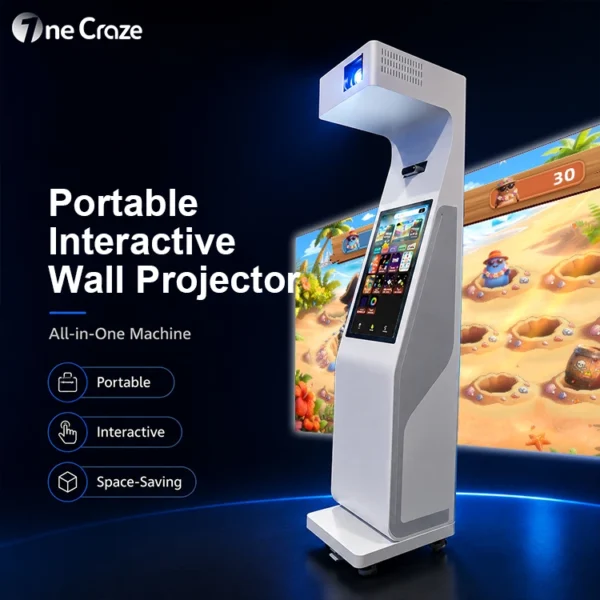
White labeling does not automatically transfer source-code ownership. The agreement should distinguish customer-owned logos and translations from supplier-owned game engines, tools and reusable modules. Buyers evaluating a portable branded platform can review the OneCraze wall projector all-in-one machine and confirm which launcher, touchscreen and game elements can display the distributor’s identity.
Can One Multilingual Platform Support Different Motion Sensors?
The language layer and the motion sensor perform different jobs. Arabic menus do not change how a depth camera detects a player, but the software still needs a compatible sensor profile, calibration process and game build. Consequently, a multilingual platform should not be described as hardware-independent unless the supplier has tested every supported configuration.
The project may use:
- Infrared sensing for touch or close-wall interaction
- A depth camera for body movement and gesture games
- Radar for ball speed or defined motion events
- LiDAR for spatial zones and distance detection
- A combination of sensors for a specialized attraction
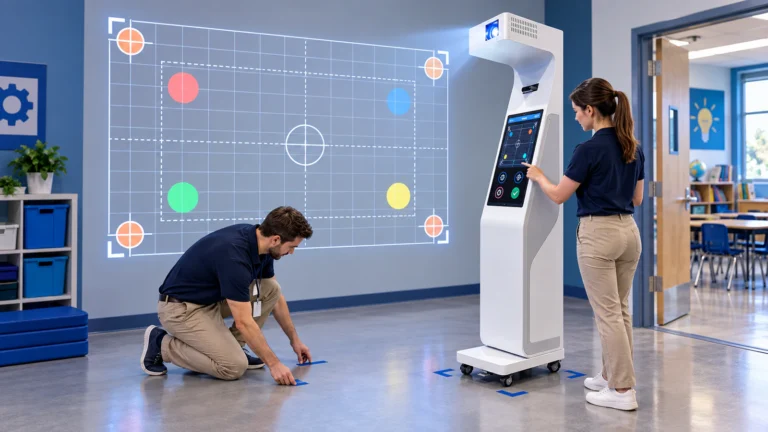
Each device may require a specific driver, mounting position and calibration file. Furthermore, operator instructions must explain the process in the supported language. A localized game is incomplete if the player interface is Arabic but the technician must troubleshoot an English-only calibration utility without training.
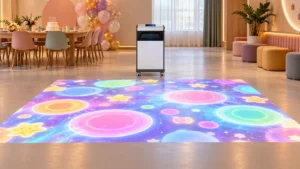
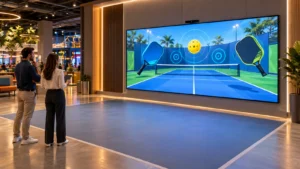
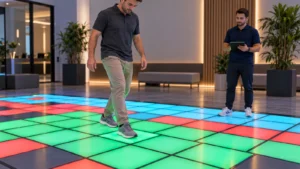
For a detailed hardware comparison, see LiDAR vs infrared camera vs depth sensor. Buyers can also examine a motion sensor interactive projector to understand how the tracking device, computer and visual content operate together. OneCraze explains the broader relationship between software and hardware in its guide to interactive floor and wall projector game functionality.
What Should an Interactive Projection API Support?
An API can connect the interactive game to membership, booking, scoring, lighting or central management systems. For multilingual projects, it must also exchange text without damaging Arabic characters or displaying fields in the wrong direction.
The integration specification should identify:
- Player login method, such as QR code, member ID or booking number
- Data sent to the game, including name, language, session and difficulty
- Data returned by the game, including score, duration, level and machine ID
- Character encoding and supported field length
- Direction handling for Arabic names mixed with numbers or Latin characters
- Authentication, network and data-retention requirements
- Behavior when the external service or internet connection is unavailable
- Test environment, sample records and final acceptance cases
Systems should preserve text using a modern Unicode-capable data path. Developers should not store Arabic names in image files or use visual-order text as a substitute for correctly encoded characters. The Unicode Bidirectional Algorithm provides the underlying rules used by many software platforms to display mixed right-to-left and left-to-right text.
The software may support live language switching, but the buyer should specify where the switch appears and whether it changes the current game, the next game or the complete system session. The supplier should demonstrate the final behavior before delivery.
It can, if the game, fonts, language files and license are stored locally. Features such as cloud leaderboards, remote management or membership login may still require a network connection.
Not automatically. Language files may transfer between systems, but infrared sensors, depth cameras, radar and LiDAR can require different drivers, calibration and game logic. The manufacturer should approve each hardware configuration.